


Risk Management
The Obayashi Group will improve its corporate value and fulfill its social responsibilities to its stakeholders by accurately grasping and preventing risks associated with corporate activities and minimizing the impact of their occurrence. We have established a risk management system that encompasses the entire group.
Risk Management System
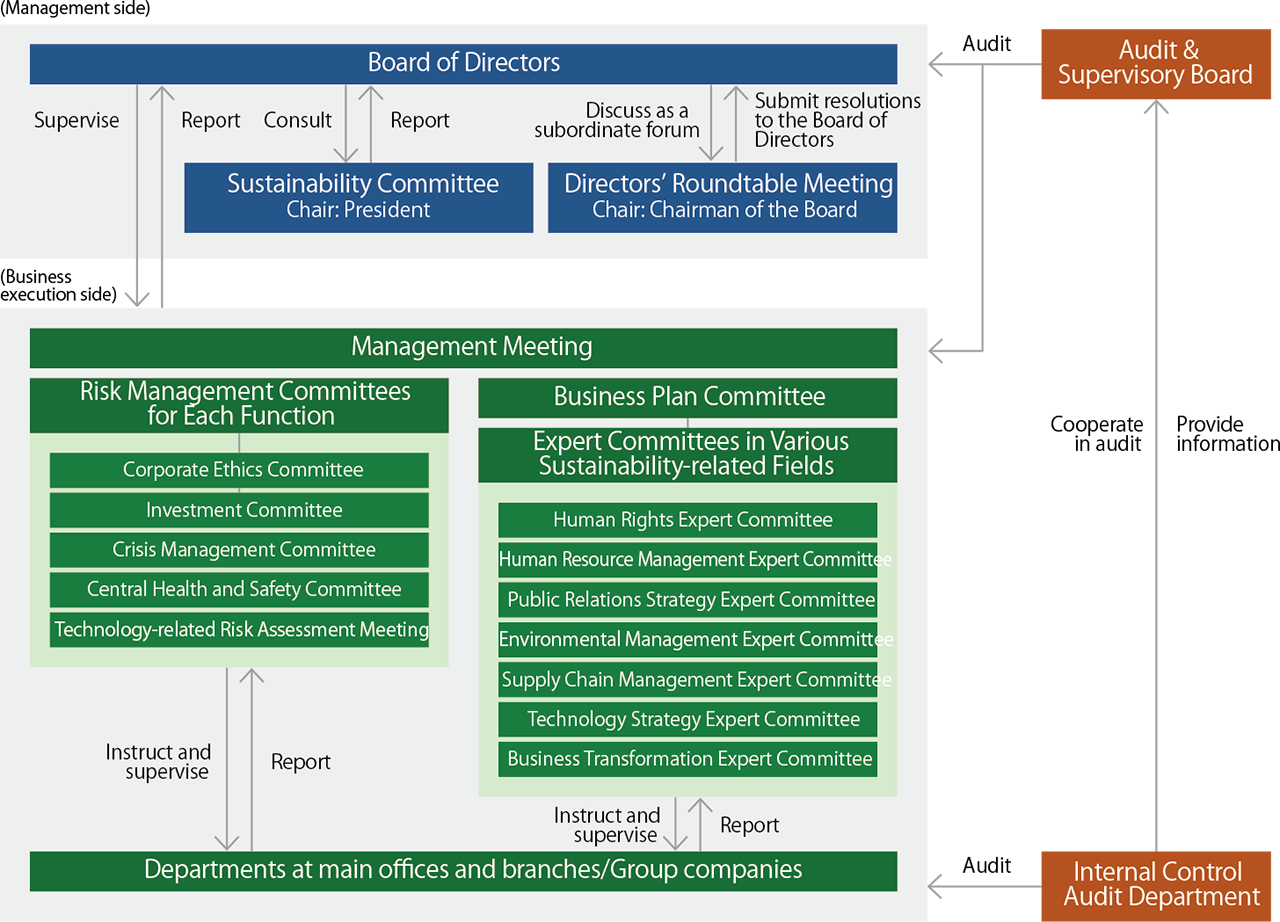
Obayashi identifies and analyzes any risks that might impact the Group through function-specific risk management committees, such as the Corporate Ethics Committee and the Central Health and Safety Committee, and the Business Plan Committee and its various subordinate committees for each sustainability-related fields. Important decisions are referred to the Board of Directors and Management Meeting for discussion. These bodies determine and evaluate the risks related to each agenda item. They discuss whether the determined response to the potential manifestation of a particular risk is appropriate and make decisions accordingly. In addition, each department assesses the risks inherent in its business processes and builds any necessary avoidance and mitigation measures into those processes. The Internal Control Audit Department, which is Obayashi's internal audit arm, audits each department's risk management efforts.
Information Security
Obayashi established an information security policy in FY2001 and started developing more detailed security measures. However, the way in which people use information systems is changing as digital technology advances and work style reforms progress, and external attacks on information systems are becoming increasingly sophisticated. Consequently, the Company' s policy was fully revised in March 2021 to better deal with growing information security risk. The revision expands the scope of application to the entire Obayashi Group and ensures that the policy conforms with the unified standards of the National center of Incident readiness and Strategy for Cybersecurity (NISC), which was reorganized into the current National Cyber Office (NCO). It has also been renamed the Obayashi Group Information Security Policy. Since then, the policy has been updated and communicated annually to deal with new information technologies and devices. This unified framework ensures the Group conforms with Japanese and overseas laws, regulations, standards, and other rules on information security frameworks including Computer Security Incident Response Team (CSIRT), training, auditing, and safety management measures. The new policy sets concrete standard measures with which Obayashi Group companies must comply. We will work to raise the level of information security throughout the Group by implementing these practices.
Obayashi Group Information Security Policy (Basic Policy)
- To protect information assets owned by OBAYASHI GROUP and provided by the clients and others from risks caused by inevitable force, risks caused by information handling, and risks caused by external attacks or unauthorized access, the company shall establish the information security management system, and take the preventive measures in preparation for emergencies.
- The company shall review the company's information security management system at planned intervals to ensure and continually improve the suitability, adequacy and effectiveness.
- The company shall continually train all users and owners of information assets so that they are aware of the importance of information security management and proper handling of information assets.
- Users and owners of the information assets shall comply with the company's information security related standards and strive to contribute to the effectiveness of the information security management system.
- Users and owners of the information assets shall comply with laws, regulations and social norms related to information security.
Information Security System
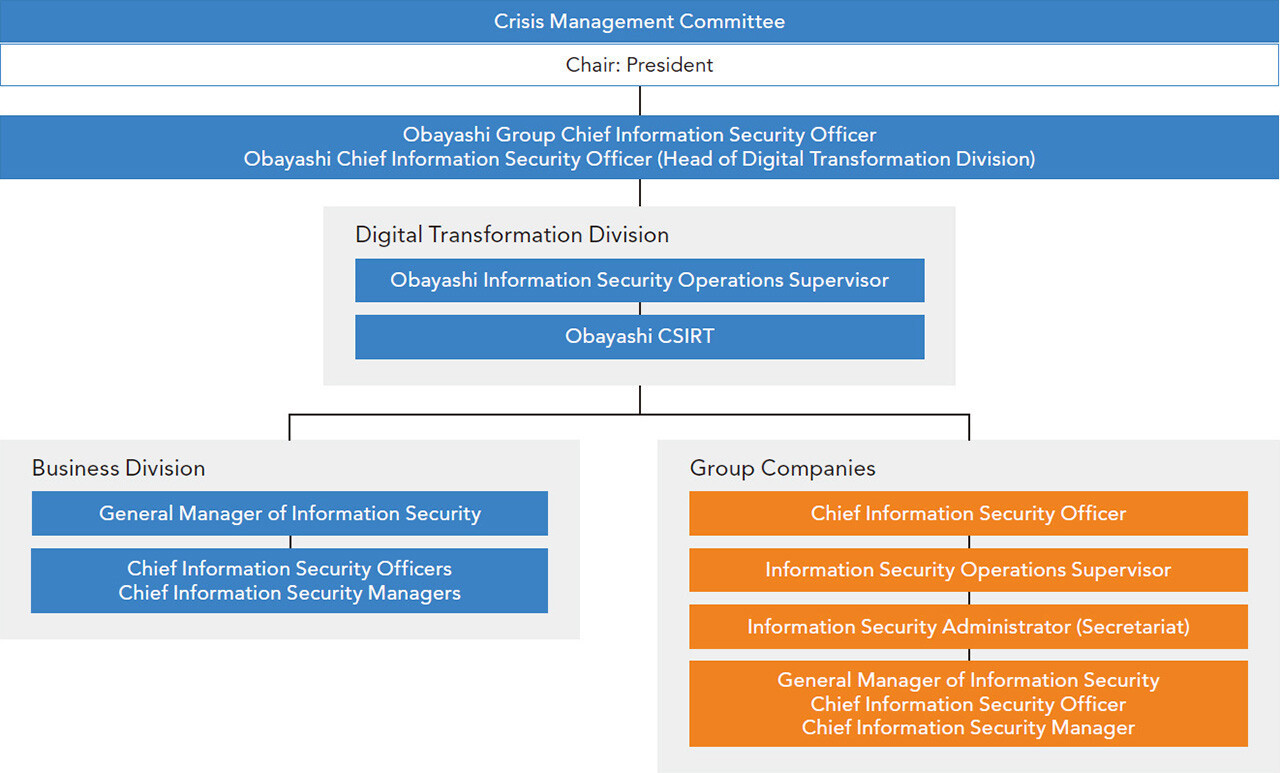
In addition, we provide trainings on information security to all employees and subcontractor staff twice a year. These trainings are to reaffirm rules related to information security and privacy, and to cultivate a sense of awareness of the users and managers of information assets. We also have a Personal Information Protection Policy (Obayashi Corporation Privacy Policy), established in 2005 as information was becoming a big part of society.
Business Continuity Plan Initiatives (BCP)
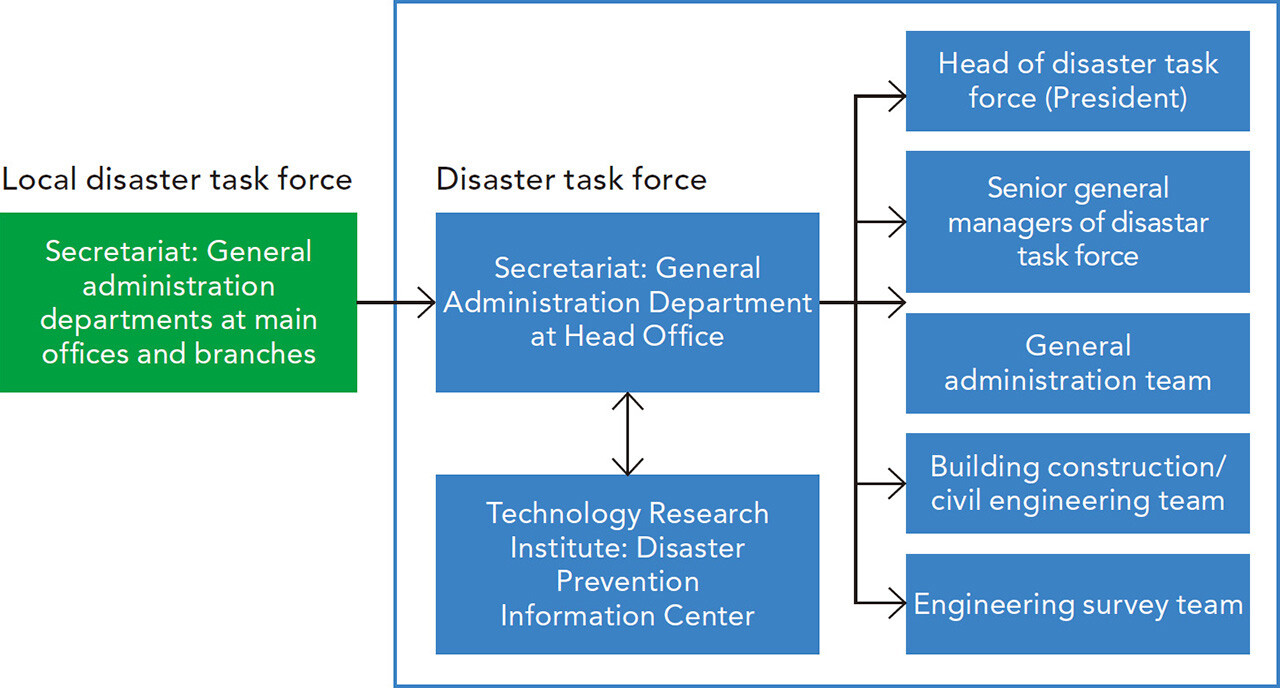
The Obayashi Group has formulated a BCP to anticipate disaster risks, such as large-scale earthquakes, and is drafting and implementing measures to prevent business interruptions and to recover quickly in the event of a disruption.
As part of its BCP, the Company strives to always maintain a solid supply chain of people and goods to help eliminate various bottlenecks that would become key obstacles when attempting to conduct business in the event of a disaster. This is done by establishing, in advance, systems relating to personnel and suppliers and subcontractors as well as measures to secure materials, equipment, fuel, and other vital supplies required for ensuring business continuity and restoring infrastructure. For example, the Company has set up a system to instantly check the safety of employees and receive damage updates from construction sites, Company facilities, Group companies, suppliers and subcontractors in the event of an earthquake-related disaster. The system enables the Company to swiftly identify the extent of damage and the operable parts of the supply chain. Obayashi also secures the resources it needs to ensure business continuity by establishing multiple potential channels in regular times in terms of logistics bases and vehicles that can be operated during a disaster, and signing disaster support agreements with fuel supply companies.
Furthermore, the Company enlists the cooperation of all main and branch offices for earthquake disaster drills that are conducted in May each year, and branch-specific earthquake disaster drills are conducted independently by individual branches every November, both to confirm initial BCP response and identify any issues. The Company addresses any issues that emerge during the earthquake drills through appropriate PDCA cycle implementation in an effort to further improve its BCP.
Risk Evaluation
Obayashi's internal audit department conducts a company-wide survey and interviews each year. The department identifies economic, social, and environmental risks and reviews the effectiveness of the risk management process. The contents of that assessment are discussed by the Board of Directors.
As for the financial auditor, we review its structure and quality every year, and select an appropriate company. Obayashi also communicates important information concerning the company to stakeholders in a fair and timely manner on the TDnet system provided by the stock exchange for timely disclosure.
Business Risks
Below business risks are listed on the 122nd Securities Report, Section 3 [Business Risks*] (Available only in Japanese). These are information that is judged to have the potential to affect the Group's business performance or corporate evaluation. The forward-looking statements in the text are the judgments of the Obayashi Group as of the end of consolidated fiscal year ending March 31, 2026.
| (1)Legal regulations on business | Amendment, establishment, or charge of applicable standards of laws and regulations, such as the Construction Business Act, Building Standards Act, Real Estate Brokerage Act, Antimonopoly Act, and Industrial Safety and Health Act and the expenses associated with complying with such laws and regulations would be reflected in business income and expense and could impact business results. To address such risks, the Obayashi Group continually monitors trends in the establishment, amendment, and abolition of legal regulations in each business division and the Legal Department, and works to accurately reflect the accompanying costs in income and expenditure forecasts for estimating costs and making decisions on business feasibility. |
|---|---|
| (2)Construction market trends | If the credit of a customer, subcontractor, or joint construction company becomes unstable and funds cannot be collected or construction is delayed, this could affect the performance of the Obayashi Group. To address such risks, the Obayashi Group conducts thorough credit checks before and during transactions and secures transactions terms for receipt of payments for construction and payment for construction according to the degree of completion in its construction business, which is the core business of the Group. |
| (3)Construction work problems and serious accidents |
If a major defect occurs in any aspect of design, construction, etc., or a serious accident involving a person, structure, etc. occurs, this could result in the expense of a large payment for compensation and affect the performance and corporate value of the Obayashi Group. To address these risks, the Obayashi Group acquired ISO 9001 certification, an international standard for quality management systems, and built a strict quality management system. The Group also established the Safety, Quality & Environment Division and established a comprehensive system for managing safety and quality. The Group also hedges such risks by enrolling in construction insurance, liability insurance, and other types of insurance. |
| (4)Customer/vendor credit risk | If the credit of a customer, subcontractor, or joint construction company becomes unstable and funds cannot be collected or construction is delayed, this could affect the performance of the Obayashi Group. To address such risks, the Obayashi Group conducts thorough credit checks before and during transactions and secures transactions terms for receipt of payments for construction and payment for construction according to the degree of completion in its construction business, which is the core business of the Group. |
| (5)Changes in construction material prices and labor unit prices |
A sudden rise in construction material prices, difficulty in procurement, rise in labor costs, or shortage of skilled workers, could cause a decline in profitability due to an increase in construction costs or payment of damages due to delays in the construction period, etc. in the construction business, which is the core business of the Obayashi Group. This could affect Group performance. To address such risks, the Obayashi Group continually ascertains the future construction capacity of the Group based on assessment of excess construction capacity of subcontractors, etc., and strives to maintain the level of orders received in line with this. When overseas procurement is used for domestic construction, the Group arranges forward exchange contracts as needed to hedge risks. The Group also formed the Rin-yu-kai, an organization of suppliers that provide mutual support, in each region and is working to build a stable supply chain, while also working to develop labor-saving automation technologies, machinery, and other equipment. It also works to purchase early, ascertain accurate costs, including future predictions, and calculate appropriate cost estimates. Furthermore, the Group strives to build relationships with multiple suppliers and seek alternative materials, while working to enhance risk communication efforts such as identification of possible concerns and countermeasures with internal and external parties to diversify and minimize risks. |
| (6)Pricce fluctuation of assets | If the market value of real estate for sale, business real estate, investment securities, etc. held by the Group declines significantly, this could result in the recognition of valuation losses or impairment losses and affect the performance and financial base of the Obayashi Group. To address such risks, the Obayashi Group formulates investment plans that balance investments with consideration of the financial base in its medium to long-term business plans. The Group also sets decision-making and screening standards for individual investments and investments are strictly screened in advance by the Investment Committee, etc. After acquisition, the management of the entity acquired, business conditions, and market price of investments are checked regularly. |
| (7)Long-term business risks | If a significant change occurs in the business environment during a PPP project or renewable energy project that has a long project term, or a serious accident occurs during the course of a project, this could result in deterioration in the profitability of the project in question and the posting of losses due to the cost of the response, and could affect the performance and corporate value of the Obayashi Group. To address such risks, the Obayashi Group prepares in advance by formulating medium to long-term investment plans that take the balance with the financial base of the Group into consideration and strictly screens investments, as stated above in "Price fluctuation of assets." The Group also hedges risks through appropriate allocation of risk with business partners and subcontractors, enrolling in insurance, and taking other steps to mitigate risk according to the business scheme. Moreover, the Investment Committee and related divisions also monitor a project as needed after it begins, and endeavor to prevent the expansion of losses by exiting projects, depending on the profit conditions. |
| (8)Risks in overseas business | In Asia, the U.S. and other countries where the Obayashi Group operates its business, a significant change in the business environment, such as political instability due to terrorism or conflict, fluctuation in economic conditions, sudden fluctuations in exchange rates, change in legal system, or other significant change could affect the performance of the Obayashi Group. To address such risks, the Obayashi Group operates its business in countries and regions having relative stable political climates and works to accurately ascertain conditions in the supervised region and respond in a timely manner in the Asia and North America Group branches (located in Singapore and the U.S.). To mitigate currency risk, the Group also receives payment for contracted work in the local currency and pays subcontractors in the local currency and uses the same currency for net sales and costs, in principle. When procuring materials overseas for domestic construction, the Group enters forward exchange contracts as needed to hedge exchange rate risk. |
| (9)Confidential information leaks | If personal information or confidential information is leaked due to external attacks, employee fraud, etc., this could result in a loss of social trust, or compensation for damages, etc., and could affect the performance and corporate value of the Obayashi Group. To address such risks, the Obayashi Group formulated the Rules on Protection of Personal Information and the Information Security Policy and established an information management system. Also, to respond to new risks associated with the increase in opportunities for external access to business systems and taking computers outside the company due to the normalization of telework, and the diversification and sophistication of cyber-attacks, the Group also regularly evaluates risks and continually responds to changes in risk through technical measures and human management through education, training, etc. to manage personal information and confidential information appropriately. |
| (10)Risks associated with large-scale natural disasters and infectious deseases |
In the event of a large-scale natural disaster such as an earthquake, tsunami, windstorm, or flood, or an outbreak of a highly contagious infectious disease, the Obayashi Group's business activities and performance may be affected due to damage to ongoing construction or paralysis of the head office or main branch functions. As a countermeasure against such risks, the Obayashi Group has formulated a Business Continuity Plan (BCP) for each type of risk, continues to provide education and training, and periodically reviews the BCP to prepare for emergencies. In the BCP for large-scale natural disasters, we promptly confirm the safety of employees, etc., and damage to construction sites in the event of a disaster, and secure restoration personnel, response bases, supplies, and distribution routes, to establish a system that enables us not only to restore sites, but also to promptly restore and support reconstruction efforts for our customers' business facilities, infrastructure, and local communities. In the BCP for infectious diseases, the basic policy is to identify and implement measures necessary to ensure the safety of employees and other personnel and business continuity in accordance with the characteristics of infectious diseases, and to reduce the impact on the business by establishing in advance the organizational structure necessary for information gathering and decision making. In addition, the Obayashi Group has secured the financial base necessary for business continuity even in the event of a major natural disaster or an epidemic of infectious diseases that seriously affects its business activities for a certain period of time. |
| (11)Climate change risks | If a carbon tax is introduced to transition to a carbon-free society, it may affect the business performance of the Obayashi Group. Furthermore, if the temperature in the summer rises or if natural disasters become more severe as physical risk, it may affect the business activities and business performance of the Obayashi Group. The Obayashi Group proclaimed decarbonization as a target for 2040 to 2050 in the Obayashi Sustainability Vision 2050 that we revised in June 2019 as a measure against those risks. In addition, we set the establishment of an environmentally responsible society (e.g., reduction of CO2 emissions) as ESG materialities and are working to reduce the environmental impact of the Obayashi Group and our entire supply chain. Moreover, we announced our support for the recommendations of the Task Force on Climate-related Financial Disclosures (TCFD) in July 2020. We are identifying and assessing climate change-related risks and opportunities and then conducting scenario analysis. Together with this, we are taking measures based on the analysis results. The natural disaster risks and measures against them are as described in (10) above. |
| (12)Risk Related to Excessive Working Hours of Employees |
Compliance with labor-related laws and regulations, including overtime work restrictions, is becoming increasingly important. Excessive working hours may adversely affect employee health and safety, reduce productivity and engagement, diminish the value of human capital, and hinder the Group's ability to attract and retain talent over the medium to long term. In addition, inadequate responses to risks arising from workforce constraints, project schedules, delivery deadlines, business practices, or other external factors may negatively affect project management and costs, resulting in a loss of social trust due to administrative guidance, penalties, or other actions, which could adversely affect the Obayashi Group's business activities and operating results. As a countermeasure, the Obayashi Group ensures proper management of working hours and identifies signs of excessive working hours at an early stage while promoting workload balancing across the organization. The Group also reviews conventional work practices and improves operational efficiency through the use of ICT tools. In the construction business, efforts are made to ensure appropriate staffing, establish effective construction execution systems, and pursue order acquisition activities based on adequate project schedules. In addition, through the promotion of flexible workstyles and the encouragement of leave utilization, the Group works to maintain employee health and create a comfortable working environment, thereby reducing these risks. |
| (13)Risks related to human rights issues across the supply chain |
If human rights issues arise within our Group or its supply chain, this could adversely affect our Group's corporate reputation and performance due to loss of social trust and credibility. As countermeasures to this risk, the Group has established the Obayashi Group Human Rights Policy and implements human rights due diligence initiatives based on international human rights norms such as the Guiding Principles on Business and Human Rights. Furthermore, based on the Obayashi Group CSR Procurement Policy and the Obayashi Group CSR Procurement Guidelines, the Group promotes the implementation of CSR procurement throughout its entire supply chain. |