


Corporate Governance
- Management Structure
- Independent Directors and Outside Audit & Supervisory Board Members
- Training of Members of the Board and Audit & Supervisory Board Members
- Collaboration among Audit & Supervisory Board Members, Financial Auditor, and Internal Audit Arm
- Policies for Determining Remuneration
- Establishment and Implementation of Internal Control System
- Evaluating Effectiveness of Board of Directors
- Engagement with Shareholders and Investors
- Corporate Governance Report
Obayashi believes that transparency and sound management, along with a strong corporate governance framework, are critical to maintaining society's trust.
We enhance corporate governance also to achieve sustainable growth and greater corporate value over the medium- to long-term. Specific initiatives include transparent, fair, rapid, and resolute decision-making. Such decision-making is always based on the principles of Japan's Corporate Governance Code set out by the Tokyo Stock Exchange.
Management Structure
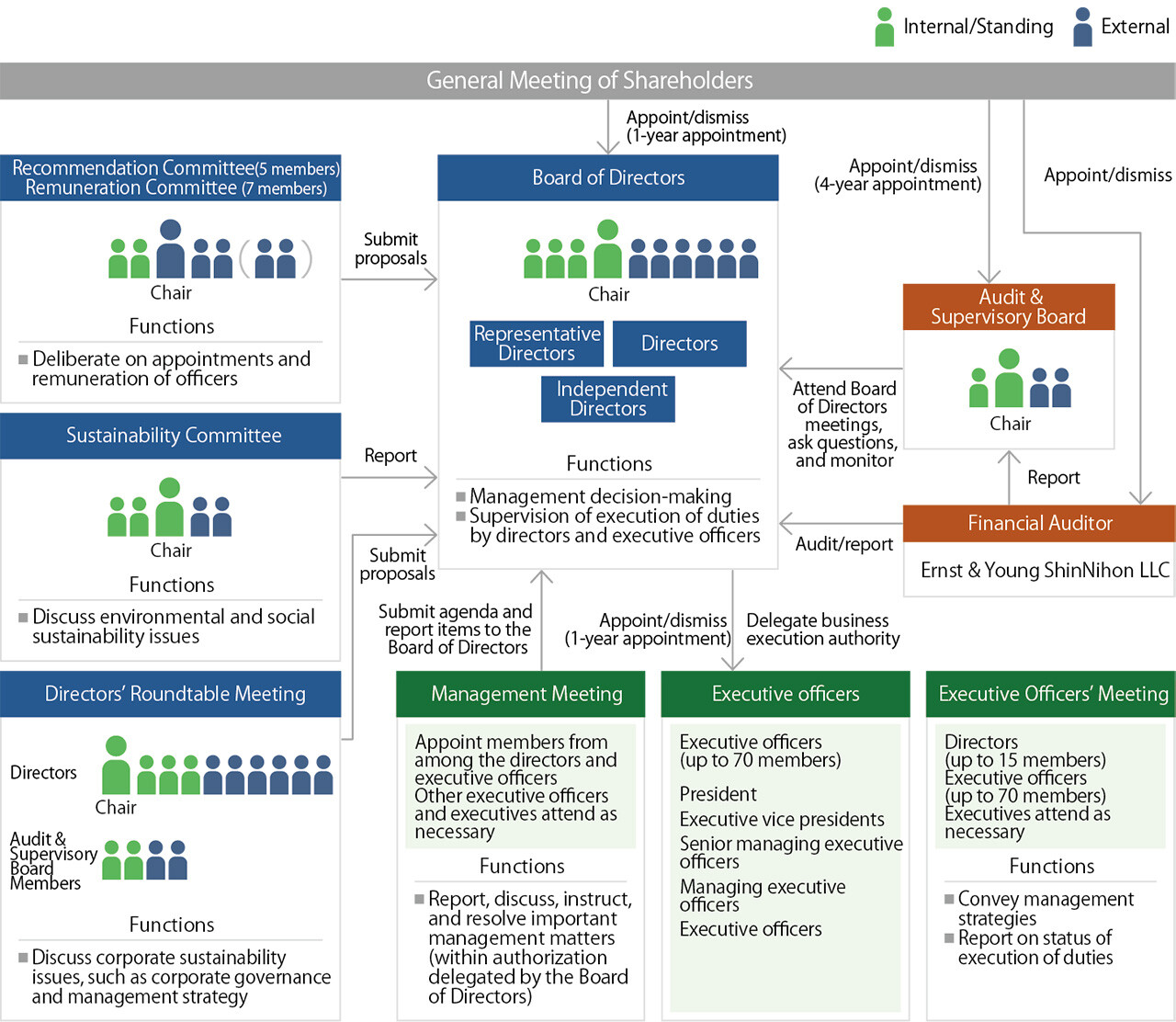
Obayashi has a General Meeting of Shareholders, Board of Directors, Audit & Supervisory Board, financial auditor, and other statutory bodies. Additionally, we have established systems for making management decisions and conducting appropriate audits. We practice precise and swift decision-making through our executive officer system and Management Meeting. The latter is composed of members appointed from among the directors and executive officers.
Management Structure
Board of Directors
The Board of Directors consists of ten members, including six independent directors. Each director participates in business decision-making and execution, and also supervises the execution of duties by other directors, executive officers, and employees. The term of each directorship is set at one year, enabling Obayashi to flexibly establish management systems in response to changes in the business environment and clarify management accountability for each business period.
To ensure the clear separation of business management and execution, the chairman serves as the chairman of the Board, instead of the president who is responsible for steering the business execution function. The chairman of the Board plays an important role in Obayashi's corporate governance. The chairman manages proceedings in the Board of Directors meetings to stimulate constructive discussion and encourage independent directors and all other attendees to freely communicate their views. The chairman also actively communicates with independent directors outside of Board meetings and provides opportunities for them to deepen their understanding of Obayashi's business and corporate culture.
Key Agenda and Items Reported in FY2025
- Matters related to business plan
- Revision of criteria for the appointment and dismissal of the president and the succession plan (matters deliberated at the Recommendation Committee)
- Revision of officer remuneration system (matters deliberated by the Remuneration Committee)
- Restructuring of the personnel system
- Reduction of cross-shareholdings
- Appointment and dismissal of directors, Audit & Supervisory Board members, executive officers, and others
- Discussion of significant investments
- Report on business risks
- Matters concerning the Board of Directors effectiveness evaluation
- Report on status of the execution of duties by the representative director
Audit & Supervisory Board
The Audit & Supervisory Board consists of four members―two standing Audit & Supervisory Board members and two outside Audit & Supervisory Board members who each serve a four-year term. Each Audit & Supervisory Board member audits the execution of duties by directors in accordance with the Obayashi Audit Guidelines for Audit & Supervisory Board Members. That process includes adopting a standpoint that is independent of the Company's directors and verifying whether the execution of duties by directors, executive officers, and employees complies with laws, regulations, the Articles of Incorporation, and other rules. They also conduct accounting audits to ensure the Company's financial statements are appropriate. When appointing a financial auditor, the Audit & Supervisory Board is tasked with confirming the appropriateness of the chosen financial auditor's performance of duties, auditing system, independence, and expertise, among other aspects.
Key Audit Items in FY2025
- Appropriate establishment of the internal control system and the status of its operation
- Fostering awareness of measures to prevent recurrence of any violation of the Antimonopoly Act, and to adhere to legal and regulatory compliance, and corporate ethics
- Establishment of the internal control system and the status of its operation at overseas subsidiaries
- Measures to prevent accounting fraud
- Appropriateness and effectiveness of business plans and initiatives
- Systems to prevent occupational accidents and quality defects
- Management of important information and measures to prevent information leakage
- Asset protection
- Measures to improve employees' job satisfaction, and initiatives to prevent harassment
- Compliance with limits on overtime work
Recommendation Committee
The Recommendation Committee is chaired by an independent director and comprises five members―two directors and three independent directors including the chair. The Recommendation Committee deliberates on the appointment of directors and submits the results to the Board of Directors. This structure is intended to clarify the officer selection process, while ensuring transparency and objectivity.
With particular regard to the appointment or dismissal of the Company president, the Recommendation Committee regularly evaluates the succession plan (appointment and dismissal criteria, selection criteria and training policy for successor candidates, and other elements) and whether that plan is being properly implemented, and submits the results of its deliberations to the Board of Directors.
The Recommendation Committee suggests people with a thorough knowledge of the business fields in which the Group is involved as candidates for executive director. It also recommends people with insight and considerable experience in corporate management as candidates for independent director, and people with diverse expertise as candidates for outside Audit & Supervisory Board member. The selection of directors is based on an individual's attributes in terms of their character, their insight, and their talent, and whether they are capable of significantly contributing to the Company's business development. Diversity-related factors, such as gender and internationality, are also taken into consideration.
Operating guidelines for the Recommendation Committee stipulate the criteria and procedure for appointing and dismissing Company directors other than the president. If an officer is considered to be potentially unfit for the job, the committee will discuss whether that officer should be dismissed in accordance with stipulated guidelines.
The Recommendation Committee met seven times in FY2025.
Key Agenda Items in FY2025
- The reappointment or non-reappointment of the Company chairman or president (conducted without the attendance of the individuals concerned)
- Recommendation of FY2026 candidates for the position of director and Audit & Supervisory Board member
- Revisions to the criteria for the appointment and dismissal of the president and to the succession plan
Remuneration Committee
The Remuneration Committee is chaired by an independent director and comprises seven members―two directors and five independent directors including the chair. The committee deliberates on issues relating to officer remuneration and submits the results to the Board of Directors. This structure is intended to clarify the process for determining the amount of officer remuneration, while ensuring transparency and objectivity.
The Remuneration Committee considers the need to continuously review the remuneration system, discusses potential revision proposals, and determines remuneration amounts for the upcoming fiscal year after evaluating such factors as the level of achievement of business performance indicators by individual directors and executive officers.
The Remuneration Committee met eight times in FY2025.
Key Agenda Items in FY2025
- Performance-linked remuneration based on FY2024 corporate results and individual performance
- FY2025 performance indicators for individual officers
- Revision of the policy for determining officer remuneration (Revision of the remuneration mix, revision of the maximum amount of remuneration for Audit & Supervisory Board members, etc.)
- FY2026 basic remuneration for officers
- FY2026 performance-linked remuneration system for officers
Sustainability Committee and Directors' Roundtable Meeting
The Sustainability Committee is chaired by the president and comprises five members―the president, two directors, and two independent directors. The Directors' Roundtable Meeting is headed by the chairman of the Board and comprises 14 members―the chairman, directors, six independent directors, two standing Audit & Supervisory Board members and two Outside Audit & Supervisory Board Members. The Sustainability Committee four and discusses environmental and social sustainability issues as an advisory body to the Board of Directors.
The Directors' Roundtable Meeting is a subordinate body of the Board of Directors and examines and discusses corporate sustainability issues, such as corporate governance and management strategy. Discussing sustainability-related issues at Board meetings based on the deliberations conducted in both the committee and roundtable helps ensure the effective and efficient monitoring, supervision, and involvement of the Board in sustainability issues, and assists with the formation of management policies that accurately capture the business environment.
Key Agenda Items at Sustainability Committee in FY2025
- Review of achievement of KPIs for each material issue in FY2024 and in the first half of FY2025
- Monitoring of efforts to reduce greenhouse gas emissions
- Monitoring of human rights due diligence and CSR procurement initiatives
- Review of the Obayashi Sustainability Vision 2050
- Review of disclosure in accordance with SSBJ standards
Key Agenda Items at Directors' Roundtable Meeting in FY2025
- Restructuring of the personnel system
- Business portfolio and strategies for individual businesses
- Consideration of introducing a CxO system
- Trends among institutional investors, their evaluation of the Company, and other information gained through means including IR meetings
Management Meeting
The Management Meeting is composed of members appointed from among the directors and executive officers. It is held to report, discuss, instruct, and resolve on important management matters and ensure precise and swift decision-making.
Executive Officers
Executive officers receive authority from the Board of Directors to execute business operations. By concentrating on their executive duties, the executive officers achieve efficient business execution.
Executive Officers' Meeting
The Executive Officers' Meeting is comprised of directors and executive officers. The meeting is held to convey management strategies and report on the status of business execution.
Overview of the Corporate Governance Structure (As of July 31, 2026)
| Form of organization | Company with Audit & Supervisory Board |
|---|---|
| Members of the Board | Number in Articles of Incorporation: Up to 15 persons Actual Number: 10 persons (Of which, independent directors 6 persons) Appointment term: 1 year Remuneration: Basic remuneration and performance-linked monetary and stock remuneration |
| Audit & Supervisory Board members |
Actual Number: 4 persons (Of which, outside Audit & Supervisory Board members: 2 persons) |
| Number of independent directors/auditors |
8 persons |
| Executive officer system | Yes |
| Financial auditor | Ernst & Young ShinNihon LLC |
| Discretionary committees | Recommendation Committee regarding directors, Audit & Supervisory Board members, and executive officers Remuneration Committee regarding executive remuneration |
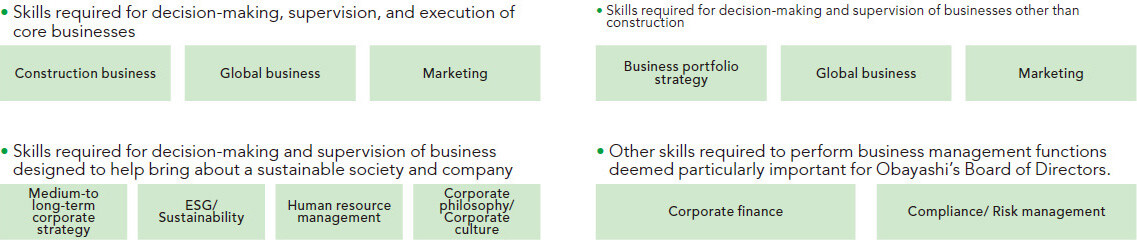
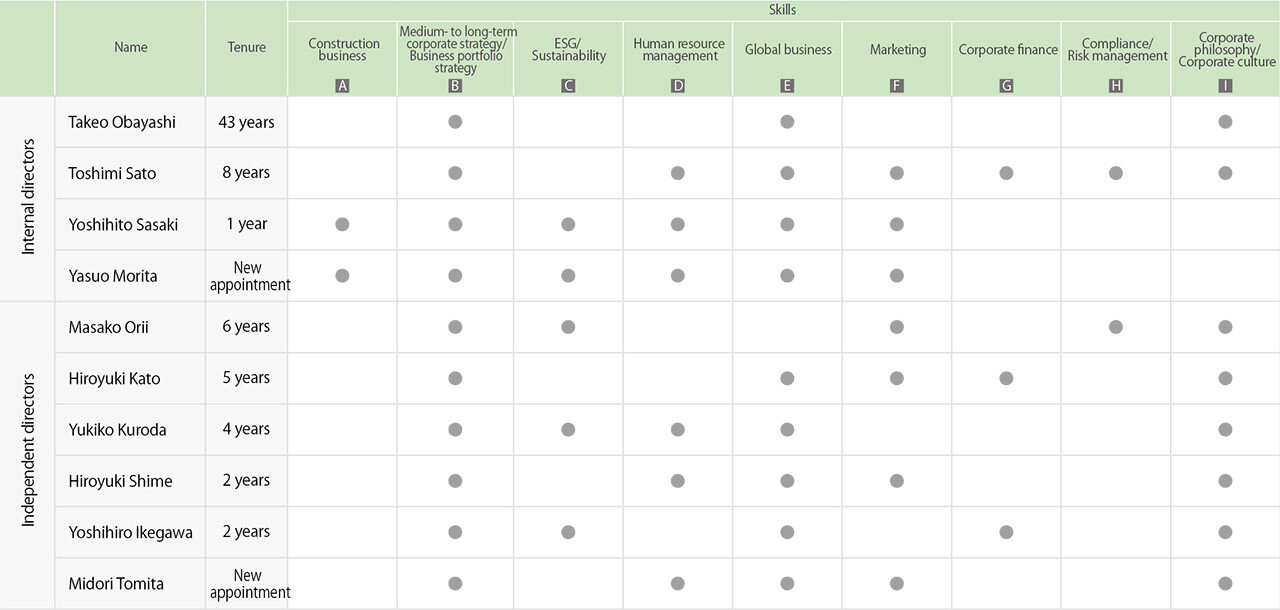
Director Skill Matrix
Independent Directors and Outside Audit & Supervisory Board Members
We have appointed five Independent directors and 3 Outside Audit & Supervisory Board members. Independent directors provide advice on improving management efficiency and supervise all aspects of management from an independent position. Outside Audit and Supervisory Board members are responsible for ensuring effective corporate governance by conducting third-party checks independent of management. Our standards for appointing independent officers (Independent directors and Outside Audit & Supervisory Board members), including standards regarding independence, are as follows:
Requirements for Selection as an Independent Officer Candidate
- 1 The Independent director(*1)/Outside Audit & Supervisory Board member(*2) candidate ("Candidate") must have capabilities, knowledge, experience, and character suitable for such position at the Corporation. The Candidate must be able to provide directions and opinions to the Corporation's management from an independent and impartial standpoint.
- 2 The Candidate must not be a former director, Audit & Supervisory Board member, or employee of the Corporation or any of its associated companies.
- 3 The Candidate must not currently belong, and must not have belonged in the past, to an Accounting Auditor, law office, or main bank with which the Corporation currently has a contract.
- 4 The Candidate must not currently be, and must not have been in the past, a major shareholder with an ownership stake of 10% or more. The Candidate must not currently belong, and must not have belonged in the past, to an entity that is a major shareholder.
- 5 The Candidate must not currently belong, and must not have belonged in the past, to an entity that has a business relationship with the Corporation in which the annual amount of transactions has exceeded 2% of the net sales of both the Corporation and such entity during the last three fiscal years.
- 6 The Candidate must not currently work, and must not have worked in the past, as an executive at a non-profit organization to which the Corporation has made an annual donation exceeding 20 million yen during the last three fiscal years.
- 7 If the Candidate does not meet the requirements in 3. through 6., at least ten years must have passed since the candidate left the relevant entity.
- 8 The Candidate must meet the requirements for an independent director/auditor pursuant to the provisions of the Tokyo Stock Exchange's Securities Listing Regulations.
*1 An outside director as per Article 2, Section 15 of the Companies Act
*2 Outside Audit & Supervisory Board member As per Article 2, Section 16 of the Companies Act
Independent Director Appointment Reasons and Activity Status
| Independent Director | Reasons for Appointment and Activity in FY2025 |
|---|---|
| Masako Orii | Ms. Orii has considerable experience, excellent capabilities, knowledge, and character gained through involvement in the management of the Suntory Group. Obayashi has appointed her in the expectation that she can provide advice and suggestions important for the decision-making regarding the Company's management policy and business strategy, from the viewpoint of a person with corporate management experience in a business area different from the Company, and based on the her abundant knowledge about ESG management, compliance, and others. She is also expected to contribute to the operation and supervision of the Company's corporate governance from a third-party standpoint as a member of the Board of Directors, chair of the Recommendation Committee, and a member of the Remuneration Committee. Term of tenure: 6 years Attendance of the meetings of the Board of Directors: 15/15 times (Attendance rate : 100%) Attendance of the meetings of the Recommendation Committee: 7/7 times (Attendance rate : 100%) Attendance of the meetings of the Remuneration Committee: 8/8 times (Attendance rate : 100%) Attendance of the meetings of the Director's Roundtable Meeting: 7/7 times (Attendance rate : 100%) |
| Hiroyuki Kato | Mr. Kato has considerable experience, excellent capabilities, knowledge, and character gained through involvement in the management of Mitsui & Co., Ltd. Obayashi has appointed him in the expectation that he can provide advice and suggestions important for decision-making regarding the Company's management policy and business strategy, from the viewpoint of a person with corporate management experience in a business area different from the Company, and based on his abundant knowledge from his experience in establishing global business strategies, and others. He is also expected to contribute to the operation and supervision of the Company's corporate governance from a third-party standpoint as a member of the Board of Directors, chair of the Remuneration Committee, and a member of the Recommendation Committee. Term of tenure: 5 years Attendance of the meetings of the Board of Directors: 15/15 times (Attendance rate: 100%) Recommendation Committee attendance: 7/7 (100%) Attendance of the meetings of the Remuneration Committee: 8/8 times (Attendance rate: 100%) Attendance of the meetings of the Director's Roundtable Meeting: 7/7 times (Attendance rate: 100%) |
| Yukiko Kuroda | Ms. Kuroda has considerable experience, excellent capabilities, knowledge, and character gained through involvement in the management of People Focus Consulting Co., Ltd., which she founded. Obayashi has appointed her in the expectation that she can provide advice and suggestions important for decision-making regarding the Company's management policy and business strategy, from the viewpoint of a person with corporate management experience in a business area different from the Company, and based on her abundant knowledge in sustainability and organizational development, and others. She is also expected to contribute to the operation and supervision of the Company's corporate governance from a third-party standpoint as a member of the Board of Directors, the Remuneration Committee, and the Sustainability Committee. Term of tenure: 4 years Attendance of the meetings of the Board of Directors: 15/15 times (Attendance rate: 100%) Attendance of the meetings of the Remuneration Committee: 8/8 times (Attendance rate: 100%) Attendance of the meetings of the Sustainability Committee: 2/2 times (Attendance rate: 100%) Attendance of the meetings of the Director's Roundtable Meeting:7/7 times (Attendance rate: 100%) |
| Hiroyuki Shime | Mr. Shime has considerable experience, excellent capabilities, knowledge, and character gained through involvement in the management of UNITIKA LTD. Obayashi has appointed him in the expectation that he can provide advice and suggestions important for decision-making regarding the Company's management policy and business strategy, from the viewpoint of a person with corporate management experience, such as serving in top management as president, and based on his abundant knowledge of business strategy formulation, and other. He is also expected to contribute to the operation and supervision of the Company's corporate governance from a third-party standpoint as a member of the Board of Directors and the Recommendation Committee. Term of tenure: 2 years Attendance of the meetings of the Board of Directors: 15/15 times (Attendance rate: 100%) Attendance of the meetings of the Recommendation Committee: 7/7 times (Attendance rate: 100%) Attendance of the meetings of the Director's Roundtable Meeting: 7/7 times (Attendance rate: 100%) |
| Yoshihiro Ikegawa | Mr. Ikegawa has considerable experience, excellent capabilities, knowledge, and character gained through involvement in the management of Mitsubishi Chemical Group. Obayashi has appointed him in the expectation that he can provide advice and suggestions important for decision-making regarding the Company's management policy and business strategy, from the viewpoint of a person with corporate management experience in a business area different from the Company, and based on his abundant knowledge in long-term management planning and sustainability, and other. He is also expected to contribute to the operation and supervision of the Company's corporate governance from a third-party standpoint as a member of the Board of Directors, the Remuneration Committee, and the Sustainability Committee. Term of tenure: 2 years Attendance of the meetings of the Board of Directors: 15/15 times (Attendance rate: 100%) Attendance of the meetings of the Remuneration Committee: 8/8 times (Attendance rate: 100%) Attendance of the meetings of the Sustainability Committee: 2/2 times (Attendance rate: 100%) Attendance of the meetings of the Director's Roundtable Meeting: 7/7 times (Attendance rate: 100%) |
| Midori Tomita *Appointed in June 2026 |
Ms. Tomita has considerable experience, excellent capabilities, knowledge, and character gained through involvement in the management of the Sony Group. Obayashi has appointed her in the expectation that she can provide advice and suggestions important for decision-making regarding the Company's management policy and business strategy, from the viewpoint of a person with corporate management experience in a business area different from the Company, and based on the abundant knowledge from her experience in establishing global business strategies, and others. She is also expected to contribute to the operation and supervision of the Company's corporate governance from a third-party standpoint as a member of the Board of Directors and Remuneration Committee. |
Outside Audit and Supervisory Board Members Appointment Reasons and Activity Status
| Outside Audit and Supervisory Board Members | Reason for Appointment and Activity in FY2024 |
|---|---|
| Shinya Kuwayama | After many years of involvement in economic, trade and industry administration, Mr. Shinya Kuwayama has considerable experience, excellent capabilities, knowledge, and character, as engaged in company management in the ALSOK Group. The Company has appointed him in the expectation of having his considerable experience and extensive knowledge reflected in audits of the Company. Term of tenure: 3 years Attendance of the meetings of ther Board of Directors: 15/15 times (Attendance rate: 100%) Attendance of the meetings of the Audit and Supervisory Board: 18/18 times (Attendance rate: 100%) Attendance of the meetings of the Director's Roundtable Meeting: 7/7 times (Attendance rate: 100%) |
| Sachiko Tsujino *Appointed in June 2026 |
As a certified public accountant who is an accounting expert, she has specialized knowledge and considerable experience in corporate accounting, as well as excellent capabilities, knowledge, and character. The Company has appointed her in the expectation of having her considerable experience and extensive knowledge reflected in audits of the Company. |
Training of Members of the Board and Audit & Supervisory Board Members
The directors make important management decisions and supervise management of the business. Audit & Supervisory Board Members audit the execution of duties by the Board of Directors, executive officers, and employees. Members of both bodies continually update their knowledge and skills relevant to these roles.
All directors, Audit & Supervisory Board Members and executive officers take a training course each year led by outside instructors. The course covers corporate governance, business risk management, sustainability, and other topics. As necessary, we also provide other training opportunities for directors and Audit & Supervisory Board Members. Such training may, for example, include external seminars. Audit & Supervisory Board Members regularly participate in external workshops to increase their understanding of their role and duties and learn the knowledge they need to perform them.
Audits by Audit & Supervisory Board Members, Financial Auditor, and Internal Audit Arm (Three-Party Auditing)
The Audit & Supervisory Board members and financial auditor each conduct audits from their independent standpoints. Audit & Supervisory Board members receive reports and briefings as required from the financial auditor. The two parties also cooperate to raise the effectiveness of audits by sharing information and opinions. Meanwhile, the Internal Control Audit Department is responsible for all audits conducted separately from the Audit & Supervisory Board members and financial auditor. Such audits are performed according to Obayashi's Internal Audit Regulations. The purpose of these audits is to monitor the effectiveness of internal control and the execution of duties by each Company department.
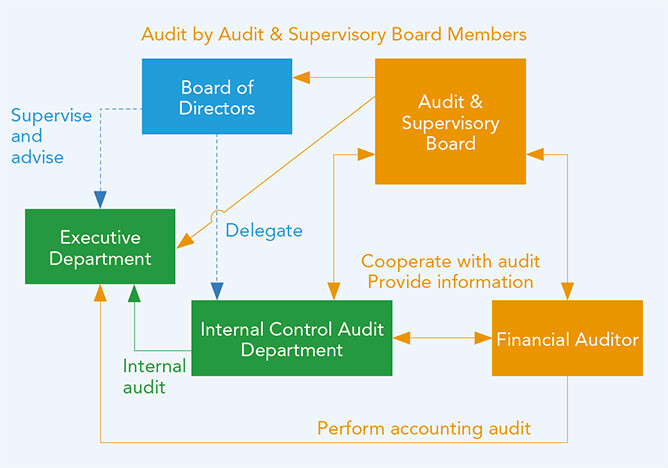
The Audit & Supervisory Board members and the Internal Control Audit Department also share information and opinions to raise the effectiveness of audits.
Policies for Determining Remuneration
The basic policy on remuneration for each director and executive officer is to provide basic remuneration, a fixed amount that is determined in advance commensurate to the responsibilities of each position, and in addition determine the amount of performance-linked cash remuneration (bonus) and performance-linked stock remuneration for each fiscal year in accordance with each person's actual contribution to business performance. The purpose is to secure outstanding human resources and provide incentive to each director and executive officer to improve earnings and enhance corporate value.
Specifically, for basic remuneration (fixed cash remuneration), the Board of Directors sets forth a table of remuneration for each position following deliberation by the Remuneration Committee (chaired by an independent director, and of which independent directors make up a majority of the membership). At the end of each fiscal year, the Remuneration Committee determines the remuneration of each director and executive officer for the next fiscal year by applying the table to each person.
The goal of performance-linked cash remuneration (bonus) is to incentivize contributions to improving business performance for each fiscal year and to enhancing corporate value. Individuals are evaluated based on predetermined Group-wide and individual performance indicator targets. Cash bonuses are paid once a year to directors and executive officers (excluding Independent directors) based on the degree of achievement of the performance indicator targets.
The performance-linked stock remuneration system is intended to incentivize contributions to improving business performance mainly over the medium to long term and to enhancing corporate and shareholder value.
We have stipulated in our rules that, if a director or executive officer with the right to receive the stock remuneration vested upon retirement is found to have committed an act of material violation, including a material breach of the duties of their position or the Company's internal rules, that person may be required to return the said remuneration.
The basic policy on Audit & Supervisory Board Member remuneration is to set an amount required to secure outstanding personnel. The ultimate aim thereby is to ensure that corporate governance functions effectively. Remuneration standards are established in advance through discussions by Audit & Supervisory Board Members. They are set separately for standing (full-time) members and outside (part-time) members.
Example Breakdown of Officer Remuneration
| Category of remuneration | Fixed remuneration | Performance-linked remuneration |
|
|---|---|---|---|
| Monthly cash remuneration (Independent directors: fixed remuneration only) |
Short-term performance-linked cash remuneration (Bonus) |
medium- to long-term performance-linked stock remuneration |
|
| Proportion of remuneration (Example: President) |
Approx. 40% | Approx. 30% | Approx. 30% |
Performance Indicators for Performance-linked Remuneration (Example: President)
| Category of remuneration | Key performance indicators (KPI) | |
|---|---|---|
| Short-term performance-linked cash remuneration (Bonus) |
Consolidated operating income, profit attributable to owners of parent per share (EPS) |
|
| Medium-to long-term performance-linked stock remuneration |
Return on equity (ROE), total shareholder return (TSR), ESG indicators (reduction in CO2 emissions, number of fatal accidents and serious injuries, employee satisfaction) |
|
Remuneration of Officers Who Have Acted Inappropriately During Their Tenure
After deliberations at the Remuneration Committee, the payment of stock remuneration will be restricted based on a resolution at the Board of Directors if a director or other executive officer falls under any of the following situations during their tenure:
1) Has committed a serious violation of duties as a director or other capacity or a serious violation of internal rules;
2) Has been discharged on the ground of a specified illegal act; or
3) Any situations equivalent to 1) or 2) above.
Total Remuneration of Members of the Board and Audit & Supervisory Board (FY2025)
| Position | Total remuneration and other compensation (millions of yen) |
Total remuneration and other compensation, by category (millions of yen) |
Number of officers in category |
||
|---|---|---|---|---|---|
| Basic remuneration (cash remuneration) |
Performance-linked remuneration |
Of which, non-cash remuneration |
|||
| Directors (of which, Independent directors) | 588 (78) |
407 (78) |
180 (-) |
96 (-) |
10 (5) |
| Audit & Supervisory Board Members (of which, Outside Audit & Supervisory Board Members) |
114 (44) |
114 (44) |
- (-) |
- (-) |
5 (3) |
Note: The above includes four directors and one Audit & Supervisory Board member who stepped down at the conclusion of the 121st Ordinary General Meeting of Shareholders held on June 26, 2025.
Remuneration for Financial Auditor (FY2025)
| Category | Compensation paid for audit certification activities (Millions of yen) |
Compensation paid for non-audit activities (Millions of yen) |
|---|---|---|
| Obayashi Corporation | 120 | 1 |
| Consolidated subsidiaries |
90 | - |
| Total | 210 | 1 |
Name of the financial auditor: Ernst & Young ShinNihon LLC
Establishment and Implementation of Internal Control System
We have established and implemented an internal control system per the Companies Act and Ordinance for Enforcement of the Companies Act. The purpose of the system is to ensure appropriate business operations throughout the Group.
The relevant sections conduct an annual self-inspection of the operation status of this system. The Board of Directors discusses the results of this inspection and monitors if the system is operated appropriately.
Evaluating Effectiveness of Board of Directors
Once a year, Obayashi Corporation conducts an evaluation and analysis of the effectiveness of the Board of Directors as a whole. The results are reported to the Board of Directors and reflected in subsequent operations.
Specifically, each Director and Audit & Supervisory Board Member makes a self-assessment using a questionnaire, and taking account of the results of the questionnaire, we conduct an analysis and evaluation of the effectiveness of the Board of Directors as a whole while obtaining advice from an external legal office.
The self-assessment questionnaire comprises items for evaluating the Board of Directors' size, composition, management methods, state of deliberation, support systems, and more. Items evaluated are reviewed every year based on opinions of an external legal office as well as changes in roles to be assumed by the Board of Directors and other factors.
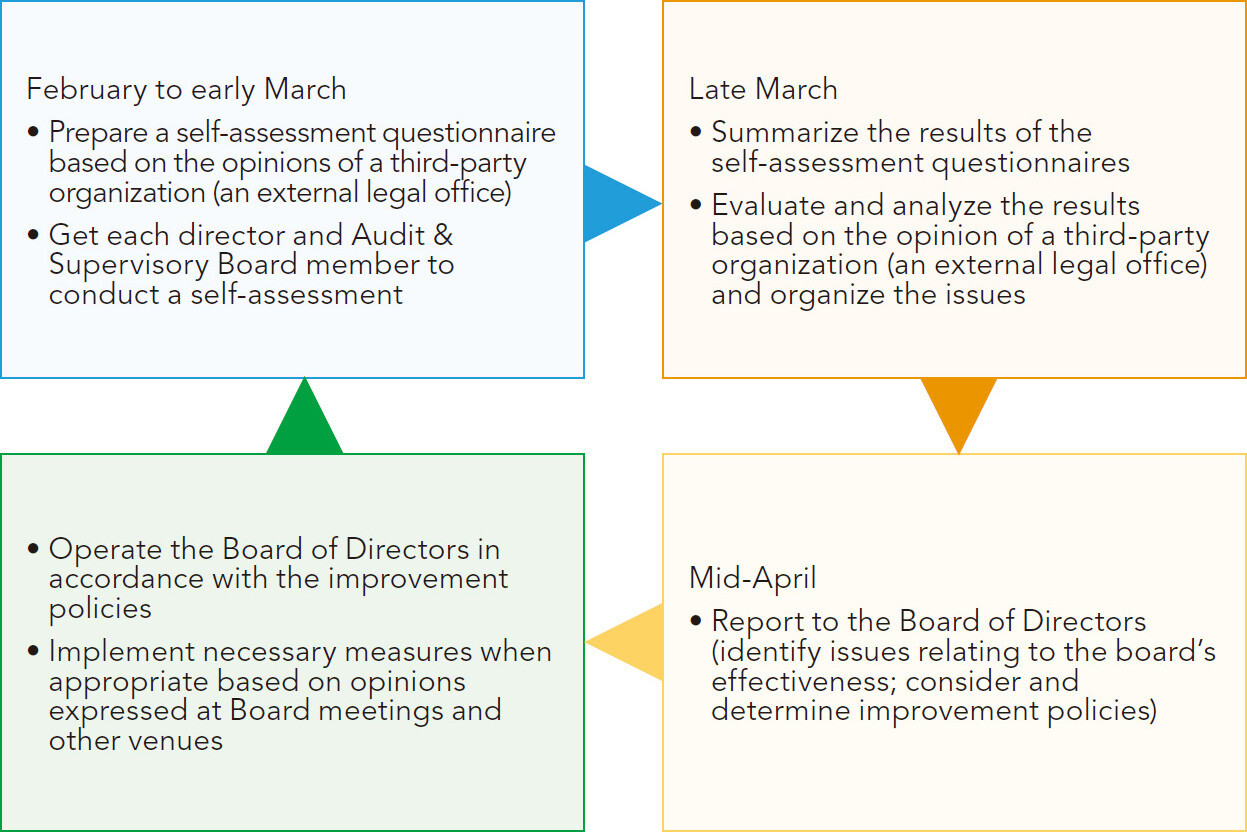
In FY2025, we confirmed that the Board of Directors continued to function effectively as a whole. Based on the results of the evaluation and analysis, we have made improvements, such as further enhancing opportunities for deliberation and discussion pertaining to the management strategies and management policies that should be focused on in board meetings.
With regard to the role of the Board of Directors and the method of its operation, in addition to making improvements based on the results of the effectiveness evaluation, we will continue to improve the effectiveness of the Board of Directors by considering and implementing necessary measures as appropriate based on the opinions of individual directors and Audit & Supervisory Board members.
Evaluating the Effectiveness of the Board of Directors
Issues Identified in FY2024
- Effective oversight by the Board of Directors of both investment in human capital and intangible assets including intellectual property and associated utilization strategies
- The ideal organizational structure for the Obayashi Group and the building of internal control and risk management systems to suit that structure
- Expansion of opportunities for providing information on business activities and performance to independent directors
▼
Actions Taken in FY2025
- Reported and discussed the executive team's progress on the restructuring of personnel systems, including scope of the management team and remuneration system reviews
- Discussed ideal organizational and governance structures for the Group's future, including the introduction of an in-house company system, a holding company structure, and C-suite executive management
- Held business briefings by each division and conducted site visits in Japan, expanded opportunities for independent directors to receive information and to communicate with senior management
▼
Issues Identified in FY2025
- Effective Board oversight of human capital and intangible assets including intellectual property, as well as the business portfolio
- Readily comprehensible explanations of agenda items; content and volume of relevant materials
- Further expansion of opportunities for providing information on business activities and performance to independent directors
▼
Action Plan in FY2026
- As part of discussions on formulating the next medium-term business plan, the executive team first presents analyses and strategic proposals relating to business strategy and platform development strategy
- Clarify key points by adding an executive summary to the agenda materials that explains the significance of initiatives in relation to the medium-term business plan, along with revenue and investment criteria, risk, and other relevant factors
- Enhance the provision of information to independent directors by offering them small-group discussions with executive directors, divisional heads, and others; and conducting Obayashi Group construction site visits, other facility tours and other means
Engagement with Shareholders and Investors
We consider the Ordinary General Meeting of Shareholders an important opportunity for engagement with our shareholders. We strive to disclose sufficient information about our business through business reports and explanations by the President and a question-and-answer session with senior management. Together with this, we are working to ensure even closer communication. Moreover, we hold financial results briefings for analysts and institutional investors and IR and SR meetings, participate in conferences organized by securities companies, holds small-group meetings, and otherwise work to enhance means of engagement, and arranges on-site visits and business briefings for the purpose of having participants deepen their understanding of our business activities.
Corporate Governance Report
In accordance with the Japanese Corporate Governance Code set forth by the Tokyo Stock Exchange, Obayashi submits a Corporate Governance Report.
-
Obayashi Corporate Governance Report (Tokyo Stock Exchange) (759 KB)
Last updated on July 31, 2026