

Earth's Soil and Planetary Soil
FUJII Kazumichi
(Unit Leader, Soil Homeostasis Research Unit, Fukushima Institute for Research, Education and Innovation)
Plants Perceive Gravity
Differences in planetary gravity have a significant impact on soil formation processes. The gravitational forces on Mars and the Moon are lower than those on Earth. It has been reported that increases in gravitational acceleration (g) affect the rhizoids of mosses (*18) (*19). These data indicate that, as gravitational acceleration increases, mosses tend to extend their rhizoids longer and deeper relative to the length of their aboveground parts. The root tip (root cap) of plants contains amyloplasts, which sense gravity and guide downward growth.
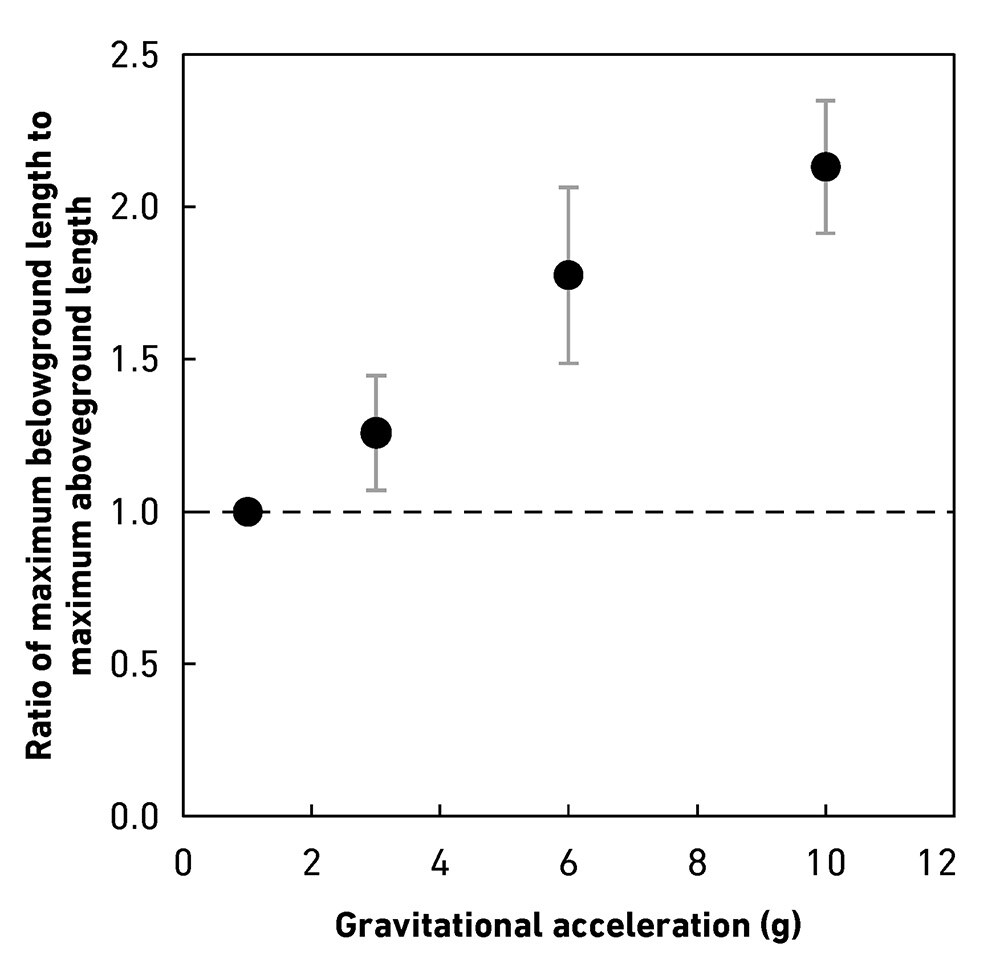
Analysis based on photographs from Hanba et al. (2025).
A similar mechanism is thought to operate in moss rhizoids, where changes in gravity alter the allocation of resources between aboveground and belowground parts. Although these observations are based on a range of approximately one to ten times Earth's gravitational acceleration (1-10 g), and caution is required when extrapolating (*20) to conditions below 1 g, it is important to note that the allocation to belowground parts may decrease on the Moon and Mars.
When the same amount of water is added to earth materials of identical particle size, the lower gravity on Mars and the Moon means that the force pulling water downward is weaker than on Earth. The upward movement of water driven by capillary rise (*21), which acts against gravity, is inversely proportional to gravity (Poiseuille's law). Under the lower gravity conditions of the Moon and Mars, capillary rise is assumed to be greater, resulting in higher water content at the same depth than on Earth. This suggests that plants may be able to take up water even with relatively shallow root systems. At the same time, soil development in the vertical direction is likely slower on the Moon and Mars than on Earth due to two factors: (1) shallow rooting depths of weathering organisms such as lichens and mosses, and (2) slower downward water percolation caused by low gravity.
*18 Root-like structures found in mosses and ferns, which do not have true roots. They anchor the plant body and absorb water and nutrients.
*19 Hanba, Y. T., Do, T. H., Takemura, K., Kitajima, S., Vyacheslavova, A., Takata, M., Fujita, T. (2025). First contact with greater gravity: Moss plants adapted via enhanced photosynthesis mediated by AP2/ERF transcription factors. Science Advances, 11(29), eado8664.
*20 Predicting or estimating values outside the range of known data based on that data
*21 The phenomenon in which a liquid rises inside a capillary tube due to capillary suction pressure when the tube is placed in a liquid
Accelerating Soil Formation
Taking a broad view of Earth's 4.6-billion-year history, life is thought to have emerged around 4 billion years ago, followed by the appearance of organisms capable of oxygen-producing photosynthesis—ancestors of cyanobacteria—around 3 billion years ago. After dissolved iron in the oceans was oxidized to form iron oxides (banded iron formations), oxygen accumulated in the atmosphere, and by about 700 million years ago the ozone layer had formed. With cosmic radiation effectively shielded, land surfaces became more hospitable, and around 500 million years ago mosses and lichens colonized rocky deserts, their remains contributing to the formation of soil. In this sense, it took approximately 4.1 billion years for soil to emerge on Earth (*22). Following the development of soil, ferns with true roots appeared, and as gymnosperms such as ginkgo, conifers, and later angiosperms emerged, soil continued to develop in depth.
Development of Terrestrial Ecosystems and Soils over 500 Million Years
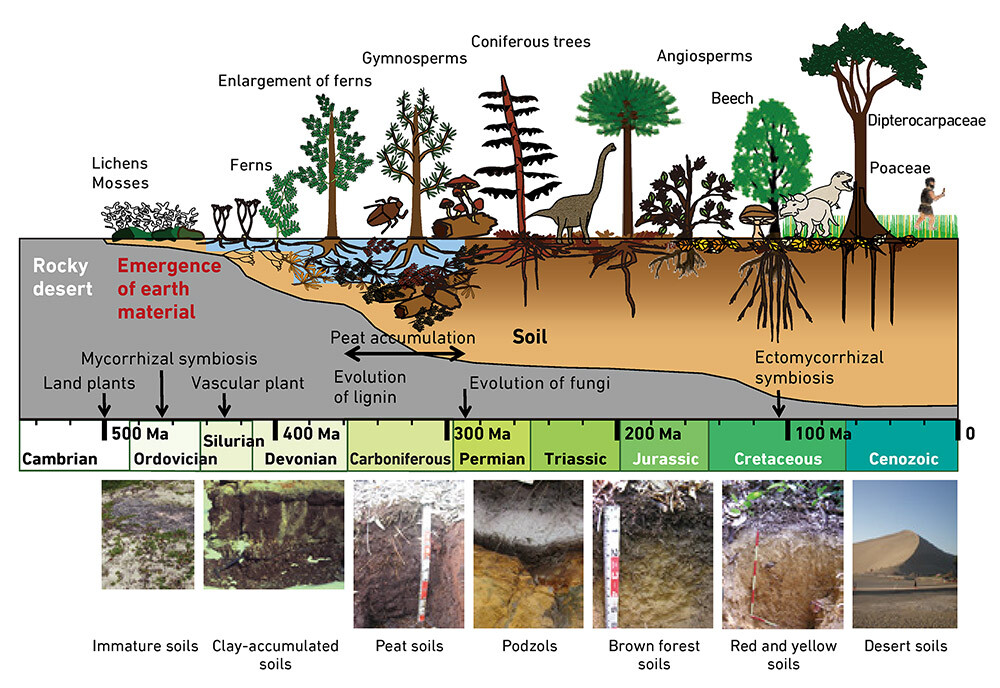
In the context of terraforming the Moon and Mars, it is not feasible to wait 4.1 billion years for earth material to form as it did on Earth. While there are high expectations for plant factories, soil will ultimately be required. The weathering processes that generate clay minerals from rock-forming minerals, in the case of aluminosilicates, require acidic substances (*23). Examples of acids that could be used include hydrochloric acid and carbonic acid. However, given that transporting 1 kg of material currently costs on the order of 100 million yen, transporting heavy chemical substances is not practical.
Regolith on Mars and the Moon is neutral to slightly alkaline, and weathering proceeds slowly under natural conditions. To generate large amounts of soil, biological activity is essential, and mosses are among the most promising candidates. Along with lichens, mosses were among the earliest organisms to contribute to soil formation on terrestrial land. They can also grow in environments without soil, where roots cannot penetrate.
*22 Fujii, K. (2022). 500 Million Years of the Earth: The Struggle Between Soil and Life (Yamakei bunko daichi no gookunen: semegiau tsuchi to ikimonotachi). Yama-Kei Publishers.
*23 Smectite formation from basaltic plagioclase: 7NaAlSi3O8 (plagioclase) + 6H+ + 20H2O → (ionization) → 3Na0.33Al2(Si3.67Al0.33)O10(OH)2 (smectite) + 6Na+ + 10H4SiO4
Practical Approaches to Terraforming
In a single tablespoon of Earth's soil, there are as many as 10,000 species of bacteria and 10 billion individual cells. Decomposition processes are not carried out by a single microorganism but rather through the division of labor among diverse microbial communities. However, about 99% of soil microorganisms are difficult to culture. It is therefore necessary to select cultivable consortia—either combinations of readily cultured microbes or those that can be maintained with the aid of helper microorganisms (for example, a set of around ten species)—and use them to decompose moss remains and convert it into humus. Regolith lacking clay has low acid-buffering capacity (*24). As decomposition products such as organic acids gradually acidify the regolith, the composition of microbial communities shifts toward groups that are more tolerant of acidic conditions. This necessitates the selection of space-adapted microorganisms capable of responding to such physicochemical changes. While phosphorus is present in Martian regolith, ensuring nitrogen—unless supplied as chemical fertilizer—requires both atmospheric nitrogen and nitrogen-fixing microorganisms.
In the science fiction film The Martian (2015), advised by NASA researchers and set in the near future of 2035, an astronaut stranded alone on Mars grows potatoes by mixing Martian sand with freeze-dried human waste left behind by his crew. In the space environment, a highly closed-loop system in which all resources are recycled is essential, and cultivation using human waste is considered a promising approach (*25). This scenario is analogous to the case of Terra Preta (*26) created thousands of years ago by indigenous peoples in the Amazon Basin of South America, who continually added charred residues from burned household waste and human waste to infertile red soil, transforming it into this remarkably fertile soil (*27). Because human waste itself is rich in nutrients such as nitrogen and phosphorus, it is necessary to determine appropriate application rates—i.e., mixing ratios with mineral materials—and to pursue crop breeding. Under conditions of limited water and nutrients, plant factories and soilless cultivation methods such as hydroponics offer significant advantages.
On the other hand, if the goal is to produce cereals and root crops capable of supporting a large population, developing soil is still essential. The significance of cultivating mosses for soil formation lies not only in the supply of nutrients and organic matter, but also in the promotion of mineral weathering, particularly the formation of clay minerals. If the process of clay formation is time-consuming, adding alternative materials may be another option. The availability of water and air (nitrogen, oxygen, and carbon dioxide) is a prerequisite.
*24 The ability of a solution to resist changes in pH and maintain a relatively constant pH when an acid is added
*25 Fujii, K. (2024). The 4.6-Billion-Year History of Soil and Life: Exploring the Mystery of Soil and Evolution (Tsuchi to seimei no yonjurokuokunenshi tsuchi to shinka no nazo ni semaru). Kodansha.
*26 Portuguese for "black soil"
*27 Glaser, B., Birk, J. J. (2012). State of the scientific knowledge on properties and genesis of Anthropogenic Dark Earths in Central Amazonia (terra preta de Índio). Geochimica et Cosmochimica Acta, 82, 39-51.
Conclusion
Terraforming is still far from a practical reality. However, as knowledge of other planetary environments accumulates, it becomes possible to view Earth's soil more objectively. At the same time, the requirements for terraforming (*28) become clearer, revealing that many of these conditions are already present in degraded environments on Earth. This, in turn, suggests the possibility of an interplanetary feedback loop, in which technologies developed for terraforming can be applied not only to extraterrestrial environments but also to the restoration of degraded lands on Earth.
*28 Radiation-tolerant mosses, a minimal microbial community (including nitrogen-fixing microorganisms), nitrogen, oxygen, carbon dioxide, and water
- The first page
- Previous page
- page 1
- Current page: page 2
- 2 / 2
FUJII Kazumichi
(Unit Leader, Soil Homeostasis Research Unit, Fukushima Institute for Research, Education and Innovation)
Born in 1981. After completing the doctoral program at the Graduate School of Agriculture, Kyoto University, he earned a Ph.D. in Agriculture. Following appointments at the Japan Society for the Promotion of Science and the Forestry and Forest Products Research Institute, he assumed his current position. His honors include the Young Scholar Award of the Ecological Society of Japan (ESJ Suzuki Award), the Encouragement Award of the Japanese Society of Soil Science and Plant Nutrition, and the Japan Prize in Agricultural Sciences, Achievement Award for Young Scientists. He is the author of The 4.6-Billion-Year History of Soil and Life: Exploring the Mystery of Soil and Evolution (Tsuchi to seimei no yonjurokuokunenshi tsuchi to shinka no nazo ni semaru), Soil: The Final Mystery of Earth (Tsuchi chikyu saigo no nazo), and 500 Million Years of the Earth: The Struggle Between Soil and Life (Daichi no gookunen semegiau tsuchi to ikimonotachi), among other works.
The issue this article appears
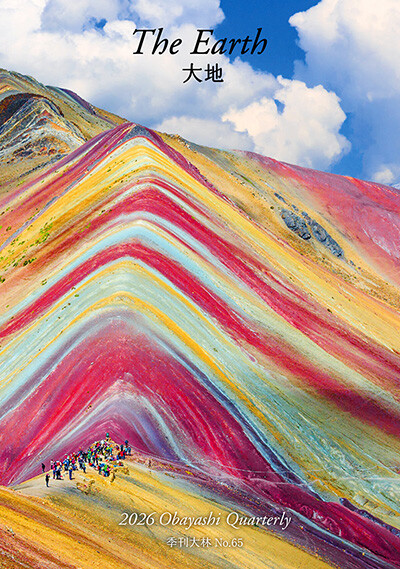
No.65 "Earth"
The earth nurtures life and sustains the rich natural environments that surround us. We live each day benefiting from its blessings. How did the earth come into being? And is there land on planets beyond Earth?
This issue explores the diverse and colorful landscapes found around the world and the ways in which they are intertwined with people’s lives. We also trace the geological processes that have shaped these distinctive landscapes. In the Obayashi Project, we took on the ambitious challenge of conceptualizing the creation of habitable terrain and the development of an environment capable of sustaining life inside a Martian crater.
We reflect on the richness and significance of the natural world nurtured by the earth and turn our thoughts to the future of our planet’s environment.
(Published in 2026)
-
The Colors and Expressions of the Earth
- View Detail
-
Earth's Soil and Planetary Soil
FUJII Kazumichi
(Unit Leader, Soil Homeostasis Research Unit, Fukushima Institute for Research, Education and Innovation) - View Detail
-
Who Owns Land in Space?: Rethinking the Ethics of Terraforming
MOTOMURA Yukiko
(Special Visiting Professor, Faculty of Life and Medical Sciences, Doshisha University; Guest Editor, The Mainichi Newspapers Co., Ltd.) - View Detail
-
Terraforming: Ecosynthesis and Ecological Restoration on Mars
Christopher P. McKay
(Planetary Scientist; Senior Scientist, NASA Ames Research Center) - View Detail
-
OBAYASHI PROJECT
Creating Habitable Terrain on Mars: Crater Paraterraforming
Concept: Obayashi Project Team
- View Detail
-
Dreams of the Red Earth: Five Hundred Years of Martian Settlement
TAKEUCHI Kaoru
(Science Writer; Professor, Faculty of Social Informatics, ZEN University) - View Detail
-
The "Earthen Houses" of Iceland
FUJIMORI Terunobu
(Architectural historian and architect; Director, Tokyo Metropolitan Edo-Tokyo Museum; and Emeritus Professor, University of Tokyo) - View Detail
-
The Earth's Memory: Landscapes Shaped by Nature and Human Life
- View Detail