

Earth's Soil and Planetary Soil
FUJII Kazumichi
(Unit Leader, Soil Homeostasis Research Unit, Fukushima Institute for Research, Education and Innovation)
Introduction
A fundamental limitation in Earth science is that there is only one Earth. It is impossible to conduct repeated trials to verify experimental errors, and reproducibility—the cornerstone of scientific validation—is difficult to test. Yet, if we could compare Earth with Mars or the Moon, we would be able to gain a more objective perspective on our own planet. Soil (*1), so ubiquitous on Earth, is in fact a unique material and spatial domain—one that does not exist on Mars or the Moon. A key question is how soil developed under Earth's distinctive conditions. In that sense, the concept of planetary terraforming can be seen as a natural extension of this line of inquiry.
*1 In this context, soil is conceived as a three-dimensional entity connected to cycles and ecological networks, while earth material is considered as a substance.
Is There No Soil on the Moon or Mars?
Soil is defined as a mixture of sand and clay produced by the breakdown of rocks, combined with humus derived from biological remains. By this definition, neither Mars nor the Moon possesses soil. The sandy deposits found on Mars and the Moon are referred to as regolith (from rhegos, "blanket," and lithos, "rock"), and are distinguished from terrestrial soil (*2). While soil—sometimes also referred to in lowercase as earth—exists on Earth, earth in this sense does not exist on Mars or the Moon.
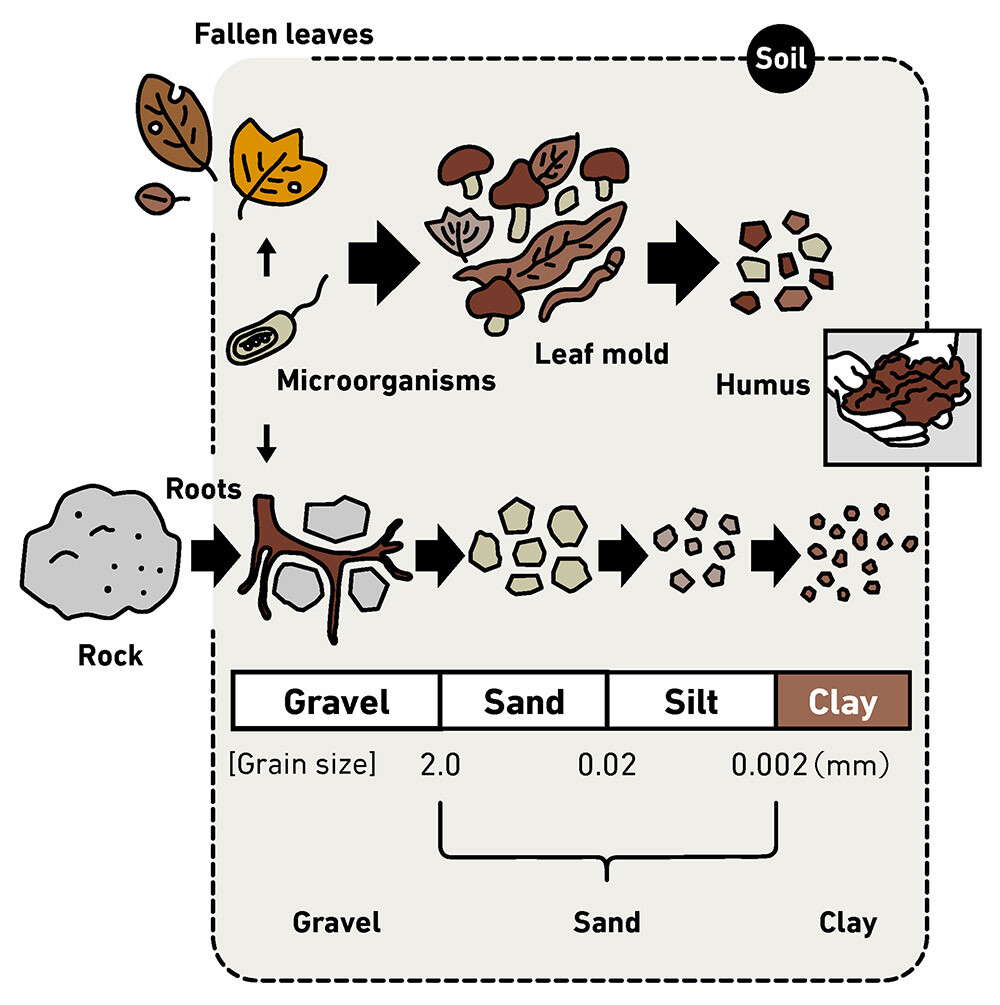
This is not a play on words; Mars and the Moon lack the components and elements required for soil formation. Most notably lacking is biological activity, along with the organic matter derived from it (excluding materials of non-biological origin). In the Viking program experiments on Mars, where amino acids labeled with radioactive carbon (14C) were added, no production of carbon dioxide (14CO2) was detected, and thus no evidence of present biological activity has been found (*3).
As seen in the National Aeronautics and Space Administration (NASA)'s use of terms such as "martian soil" and "lunar soil" for the sands of Mars and the Moon, some fields do not distinguish between "soil" and "regolith (*4)." There is no exclusive claim by soil science societies over the term "soil." Given the inherently interdisciplinary nature of this field, it is important to establish a definition of "soil" that can be accepted across disciplines, including planetary science. Indeed, calls are emerging on Earth for a definition of earth material that can be applied to extraterrestrial planets as well.
The Kojien (*5), one of Japan's most authoritative dictionaries, had long defined soil on Earth as "the uppermost layer of the Earth's crust, formed by the disintegration and decomposition of rocks on the surface of the Earth's crust, accumulating on the land surface and combining with the remains of plants and animals." In the internationally used soil classification system, Soil Taxonomy (*6), soil is described as a mixture of organic matter, minerals, gases, liquids, and living organisms. Distinguishing the boundary at the soil surface where it comes into contact with the atmosphere and water is straightforward: It is considered earth material at the point where microorganisms colonize fresh plant remains and decomposition begins. However, the lower boundary with the lithosphere (rocks and sediments) is more difficult to define and is often distinguished by the presence or absence of major biological activity, assuming the existence of terrestrial ecosystems and biological activity.
In response to such traditional, Earth-surface-based definitions of soil, many researchers have proposed revised and expanded definitions that can also be applied to extraterrestrial planets. Taken together, these definitions describe soil as unconsolidated inorganic and organic material found at or near a planetary surface, shaped by physical, chemical, and biological processes, often retaining liquids, gases, and organisms, and capable of supporting life (*7). Reflecting these developments, the Kojien (*8) has revised its definition to describe soil as "material at the surface of land that, given suitable external conditions such as light, temperature, and precipitation, can support plant growth." Compared with the earlier definition, the criteria have been relaxed, extending the concept to include even particle assemblages without biological activity. The flexible phrasing "often retaining" allows for the inclusion of environments such as plantless deserts, as well as the sands of the Moon and Mars. At the same time, soil is distinguished from bedrock and consolidated sediments: It must possess a certain thickness beyond a mere thin coating over rock, and be separable from the underlying material by alteration due to chemical weathering, regardless of whether biological or physical weathering is involved. A notable feature of this approach is that the boundary between sediment and soil—namely, whether the material has developed in response to its local environment—becomes somewhat less clearly defined.
*2 Fujii, K. (2018). Soil: The Final Mystery of Earth—Searching for Soil to Sustain Ten Billion People (Tsuchi chikyu saigo no nazo hyakuokunin o yashinau dojo o motomete). Kobunsha.
*3 Klein, H. P. et al. (1976). The Viking biological investigation: preliminary results. Science, 194(4260), 99-105.
*4 Certini, G., Ugolini, F. C. (2013). An updated, expanded, universal definition of soil. Geoderma, 192, 378-379.
*5 5th edition (first printing, 1998)
*6 U.S. Department of Agriculture, 2022
*7 Van Es, H. (2017). A new definition of soil. Csa News, 62(10):20-21.
*8 7th edition (first printing, 2018)
The Formation of Lunar and Martian "Soil"
The sands on the Moon and Mars are formed primarily through mechanical weathering of rocks. Rocks are aggregates of multiple minerals (rock-forming (*9) or primary minerals (*10)), each of which expands and contracts differently when subjected to heat. As these differences generate gaps and cracks that gradually widen, the rock breaks apart into individual mineral grains. Where water is present, cycles of drying and wetting can also cause expansion and contraction, further promoting mechanical weathering.
On the Moon, where neither water nor wind is present to erode particles, many grains remain angular (*11). The lunar crust consists of two main types of rock: the bright highlands (the background of the familiar "rabbit" pattern seen on the Moon), composed of anorthosite, and the darker maria (the areas where the rabbit appears to be making rice cakes), composed of basalt. The average grain size of lunar regolith is on the order of several tens of micrometers, and no clay minerals have been identified. What is commonly referred to as "lunar sand" would, based on grain-size distribution, correspond primarily to silt and fine sand. In this respect, it differs from terrestrial earth material in that it exhibits a single-peaked distribution.
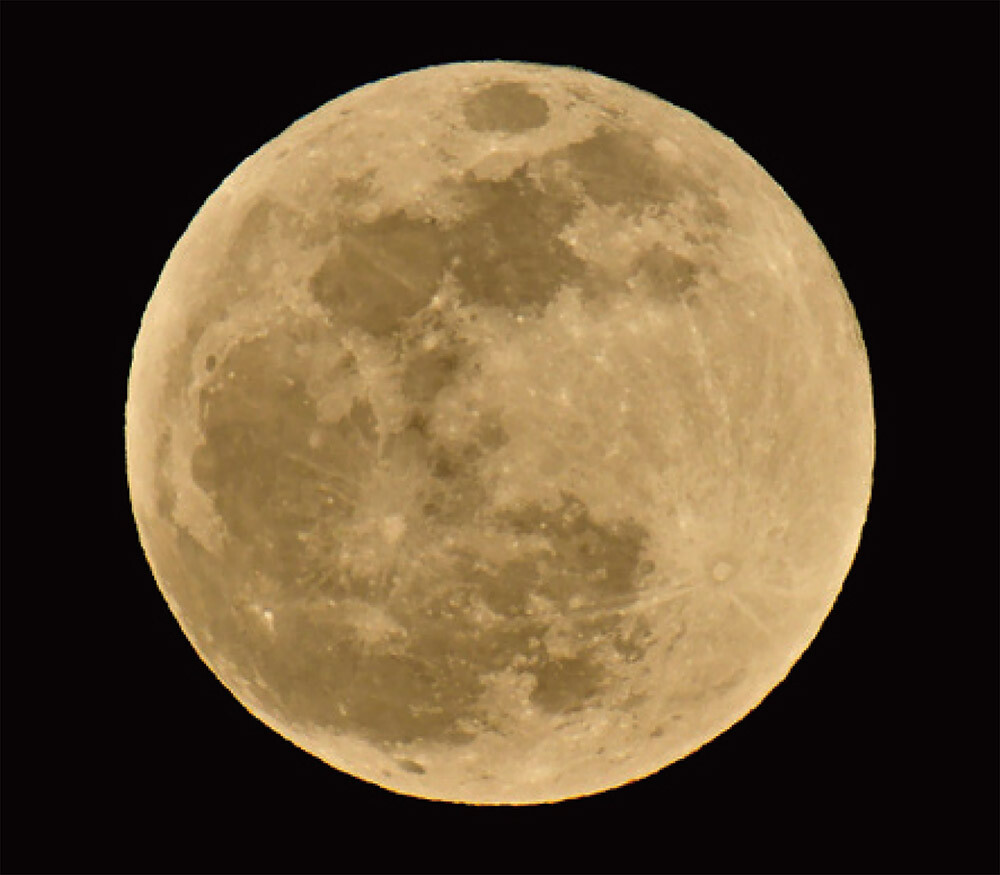
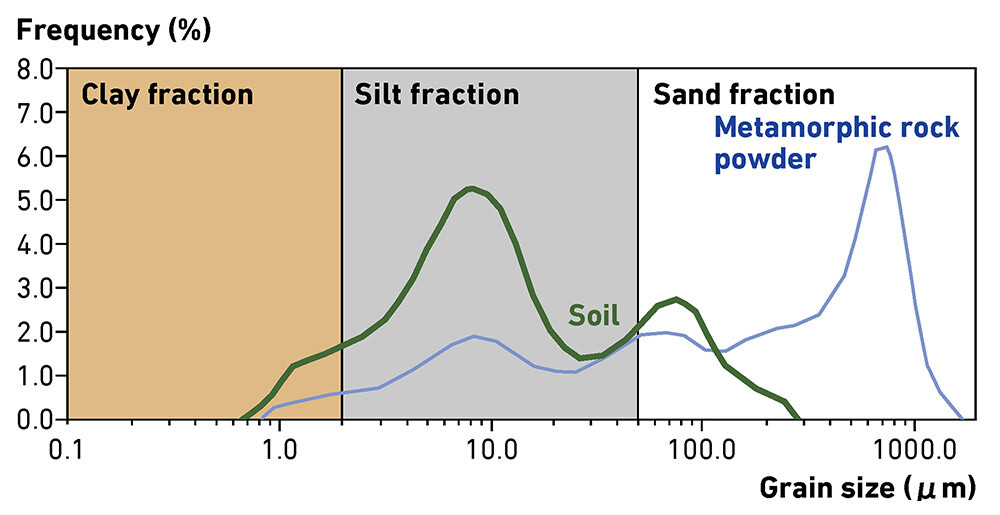
The lunar regolith data are based on a reanalysis of the data reported by Ryu et al. (2018).
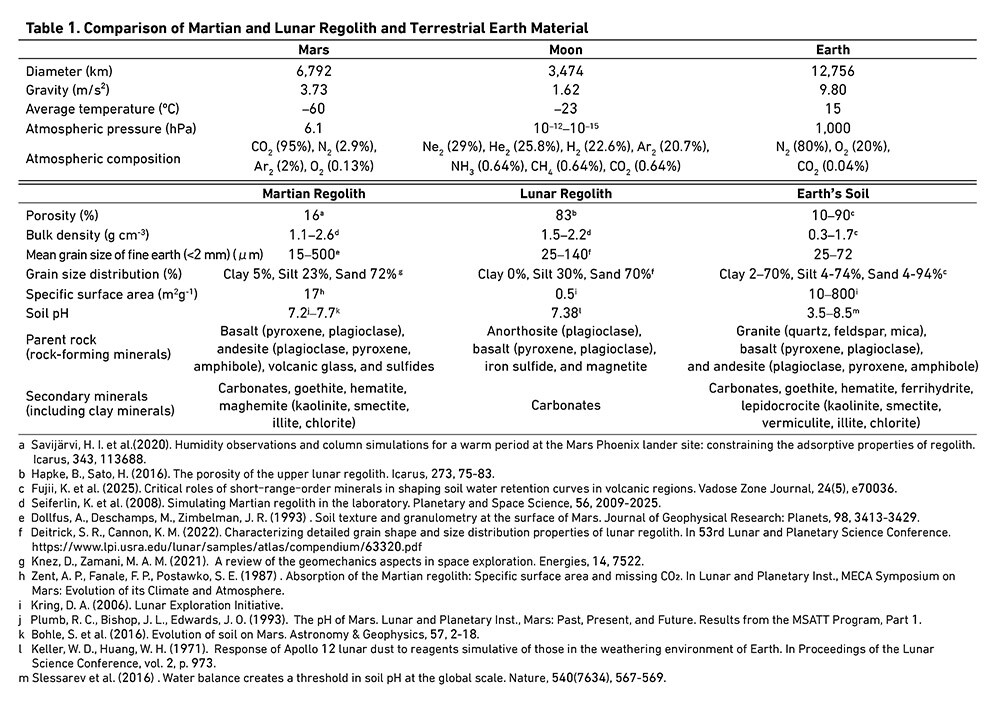
Rocks forming the surface of Mars are composed mainly of basalt and andesite. Red iron oxides are primarily made up of goethite (*12) (α-FeOOH) and hematite (*13). Kaolinite, a clay mineral, forms in water-bearing environments; therefore, its presence in geomorphic surfaces dating back billions of years has long been cited as evidence supporting the hypothesis that Mars once had a wet environment. However, this appears inconsistent with the "faint young Sun" scenario, which suggests that solar luminosity was only about 70% of its present level, implying that Mars would have been frozen (*14). After considerable debate, the leading interpretation today is that kaolinite was formed by subsurface hydrothermal activity. Ancient Martian terrain is characterized by limited erosion and a lack of evidence for plate tectonics. In any case, while Martian regolith differs from lunar regolith in that it contains clay minerals, both share the feature that their grain size distribution is dominated by grains on the order of several tens of micrometers and shows a single peak pattern.
When examining particles that are chemically distinct from rock, it becomes clear that changes in elemental composition arise mainly from grain-size sorting processes, in which heavier particles tend to settle downward. In this broad sense, Martian regolith can also be regarded as a form of earth material. However, as noted above, under current terrestrial definitions, it is not classified as soil because it lacks biological activity.
*9 Minerals that constitute the principal components of major rocks such as granite and basalt. Examples include feldspar, quartz, biotite, amphibole, pyroxene, and olivine.
*10 Minerals that crystallize during the formation of rocks, for example through the cooling of magma. In contrast, minerals formed through alteration during weathering and soil formation, such as clay minerals, are referred to as secondary minerals.
*11 Bohle, S. et al. (2016). Evolution of soil on Mars. Astronomy & Geophysics, 57, 2-18.
*12 Named after the poet Goethe, who had a keen interest in minerals
*13 "Heme" comes from the Greek word haima, meaning "blood"
*14 Ehlmann, B. L. et al. (2011). Subsurface water and clay mineral formation during the early history of Mars. Nature, 479(7371), 53-60.
Differences Between Lunar and Martian Regolith and Terrestrial Earth Material
On Earth, the crust is composed predominantly of granite. While the planet's interior core is mainly iron, soil—the surface layer of the crust—is characterized by a composition dominated by silicon and aluminum oxides. Quartz, consisting solely of silicon, together with feldspar and mica, which are composed of silicon and aluminum, constitute the principal rock-forming minerals—rich in aluminosilicates, unlike the iron-dominated regolith on Mars and the Moon. Clay minerals on Earth include crystalline clay minerals such as kaolinite, smectite, illite, and vermiculite. In addition to these, fine short-range ordered clay minerals such as allophane and imogolite are also present. They are characterized by limited continuity in their crystal structures and commonly found in volcanic ash soils like those in Japan. Iron oxides are represented not only by goethite and hematite, which are also found on Mars, but also by hydrated iron oxides such as ferrihydrite (5Fe2O3・9H2O) and lepidocrocite (γ-FeOOH), reflecting the planet's abundant water. The grain size distribution is characterized by a distinct three-peak pattern corresponding to sand, silt, and clay.
Because the Moon's gravity is insufficient to retain an atmosphere, it contains almost no gases or liquids. Lunar regolith consists of solid material (solid phase (*15)) and pore spaces that are essentially vacuum. In effect, it may be regarded as nearly 100 % solid phase. Mars, by contrast, possesses an atmosphere. Its regolith may be described as comprising approximately 5 % pore space—representing the combined gaseous and liquid phases—and about 95 % solid phase (*16).
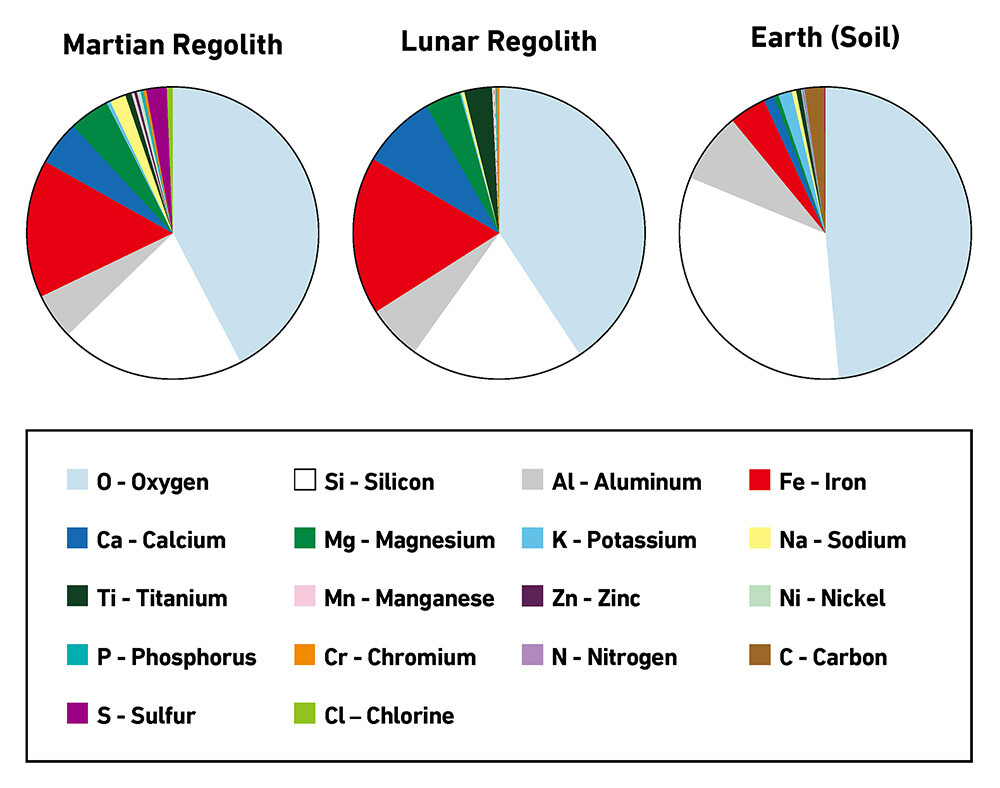
The lunar regolith data are based on a reanalysis of the data reported by Ryu et al. (2018).
In terrestrial soils, the proportions vary, but a representative example would be roughly 50 % pore space (about 30 % gas and 20 % liquid) and 50 % solid phase. It can be seen that there are significant differences in the distribution of the three phases (solid, liquid, and gas) among Martian regolith, lunar regolith, and terrestrial earth material (*17).
*15 Phase: A region of matter that is physically and chemically homogeneous throughout, regardless of which portion is considered
*16 Mitrofanov, I. et al. (2002). Maps of subsurface hydrogen from the high energy neutron detector, Mars Odyssey. Science, 297(5578), 78-81.
*17 Fujii, K., Hayakawa, C., Kosaki, T., Frouz, J., Sukartiningsih. (2025). Critical roles of short-range-order minerals in shaping soil water retention curves in volcanic regions. Vadose Zone Journal, 24(5), e70036.
- Current page: page 1
- page 2
- 1 / 2
- Next page
- The last page
FUJII Kazumichi
(Unit Leader, Soil Homeostasis Research Unit, Fukushima Institute for Research, Education and Innovation)
Born in 1981. After completing the doctoral program at the Graduate School of Agriculture, Kyoto University, he earned a Ph.D. in Agriculture. Following appointments at the Japan Society for the Promotion of Science and the Forestry and Forest Products Research Institute, he assumed his current position. His honors include the Young Scholar Award of the Ecological Society of Japan (ESJ Suzuki Award), the Encouragement Award of the Japanese Society of Soil Science and Plant Nutrition, and the Japan Prize in Agricultural Sciences, Achievement Award for Young Scientists. He is the author of The 4.6-Billion-Year History of Soil and Life: Exploring the Mystery of Soil and Evolution (Tsuchi to seimei no yonjurokuokunenshi tsuchi to shinka no nazo ni semaru), Soil: The Final Mystery of Earth (Tsuchi chikyu saigo no nazo), and 500 Million Years of the Earth: The Struggle Between Soil and Life (Daichi no gookunen semegiau tsuchi to ikimonotachi), among other works.
The issue this article appears
No.65 "Earth"
The earth nurtures life and sustains the rich natural environments that surround us. We live each day benefiting from its blessings. How did the earth come into being? And is there land on planets beyond Earth?
This issue explores the diverse and colorful landscapes found around the world and the ways in which they are intertwined with people’s lives. We also trace the geological processes that have shaped these distinctive landscapes. In the Obayashi Project, we took on the ambitious challenge of conceptualizing the creation of habitable terrain and the development of an environment capable of sustaining life inside a Martian crater.
We reflect on the richness and significance of the natural world nurtured by the earth and turn our thoughts to the future of our planet’s environment.
(Published in 2026)
-
The Colors and Expressions of the Earth
- View Detail
-
Earth's Soil and Planetary Soil
FUJII Kazumichi
(Unit Leader, Soil Homeostasis Research Unit, Fukushima Institute for Research, Education and Innovation) - View Detail
-
Who Owns Land in Space?: Rethinking the Ethics of Terraforming
MOTOMURA Yukiko
(Special Visiting Professor, Faculty of Life and Medical Sciences, Doshisha University; Guest Editor, The Mainichi Newspapers Co., Ltd.) - View Detail
-
Terraforming: Ecosynthesis and Ecological Restoration on Mars
Christopher P. McKay
(Planetary Scientist; Senior Scientist, NASA Ames Research Center) - View Detail
-
OBAYASHI PROJECT
Creating Habitable Terrain on Mars: Crater Paraterraforming
Concept: Obayashi Project Team
- View Detail
-
Dreams of the Red Earth: Five Hundred Years of Martian Settlement
TAKEUCHI Kaoru
(Science Writer; Professor, Faculty of Social Informatics, ZEN University) - View Detail
-
The "Earthen Houses" of Iceland
FUJIMORI Terunobu
(Architectural historian and architect; Director, Tokyo Metropolitan Edo-Tokyo Museum; and Emeritus Professor, University of Tokyo) - View Detail
-
The Earth's Memory: Landscapes Shaped by Nature and Human Life
- View Detail