

Terraforming: Ecosynthesis and Ecological Restoration on Mars
Christopher P. McKay
(Planetary Scientist; Senior Scientist, NASA Ames Research Center)
Mars: The once and future world for life
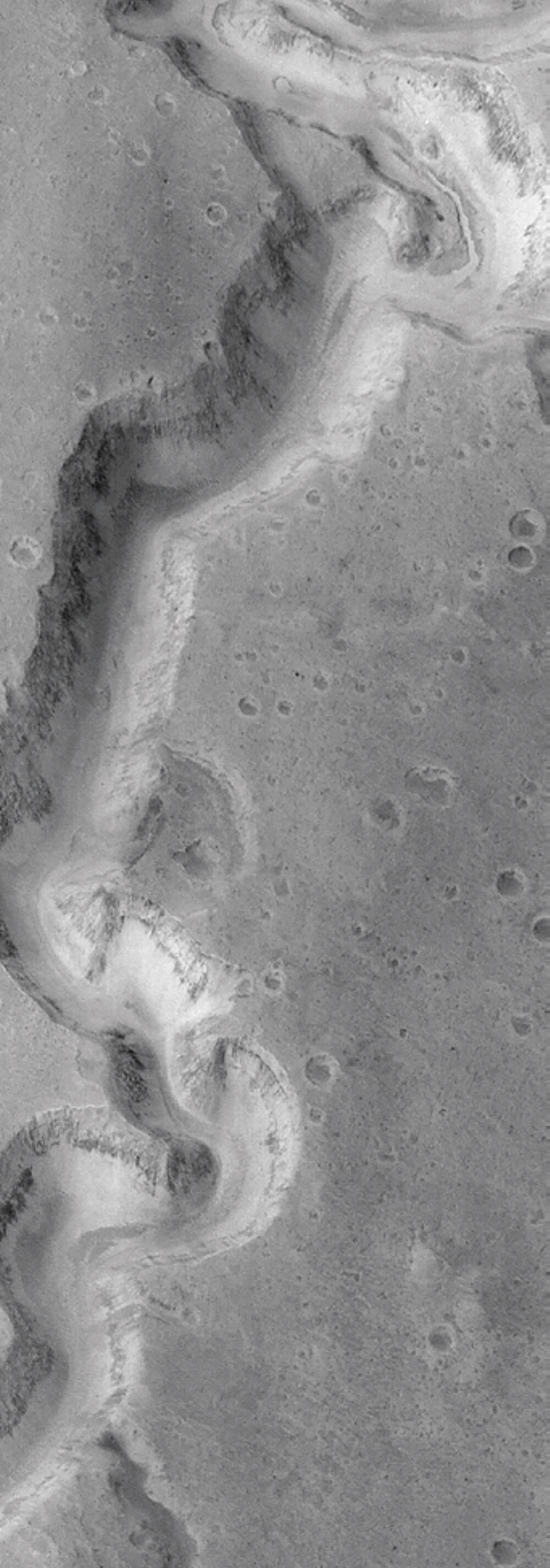
Mars has long been the focus of science fiction stories and future plans for human exploration. NASA has sent over 20 missions to Mars, more than twice as many as any other planet. There is a good reason that Mars is the focus both of our research and of our dreams: Mars was once very much like the Earth. Mars had water on its surface in the past. Images from orbiters show a range of fluvial features and channels which clearly indicate copious flowing water. It is somewhat paradoxical that in the context image, the terrain on either side of Nanedi Valles shows what appears to be an unweathered cratered surface—not unlike the Moon. This indicates that the fluvial activity must have been highly localized, episodic, and/or of brief duration—possibly all three.
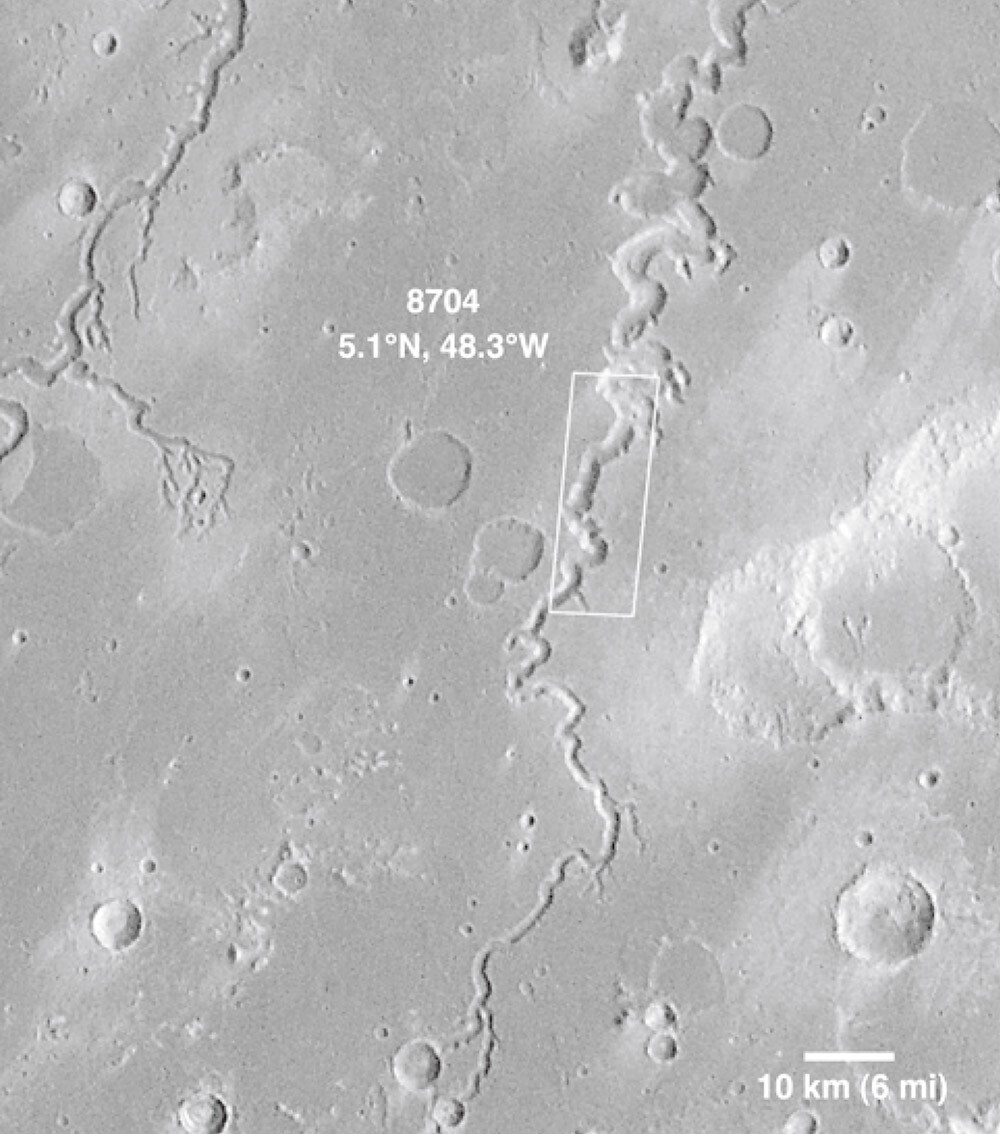
Mars Global Surveyor image showing Nanedi Valles in the Xanthe Terra region of Mars. Image covers an area 9.8 km by 18.5 km; the canyon is about 2.5 km wide. This image is the best evidence we have that some of the fluvial features on Mars were carved by liquid water in stable flow on the surface for an extended interval. Image from NASA / Malin Space Science Systems
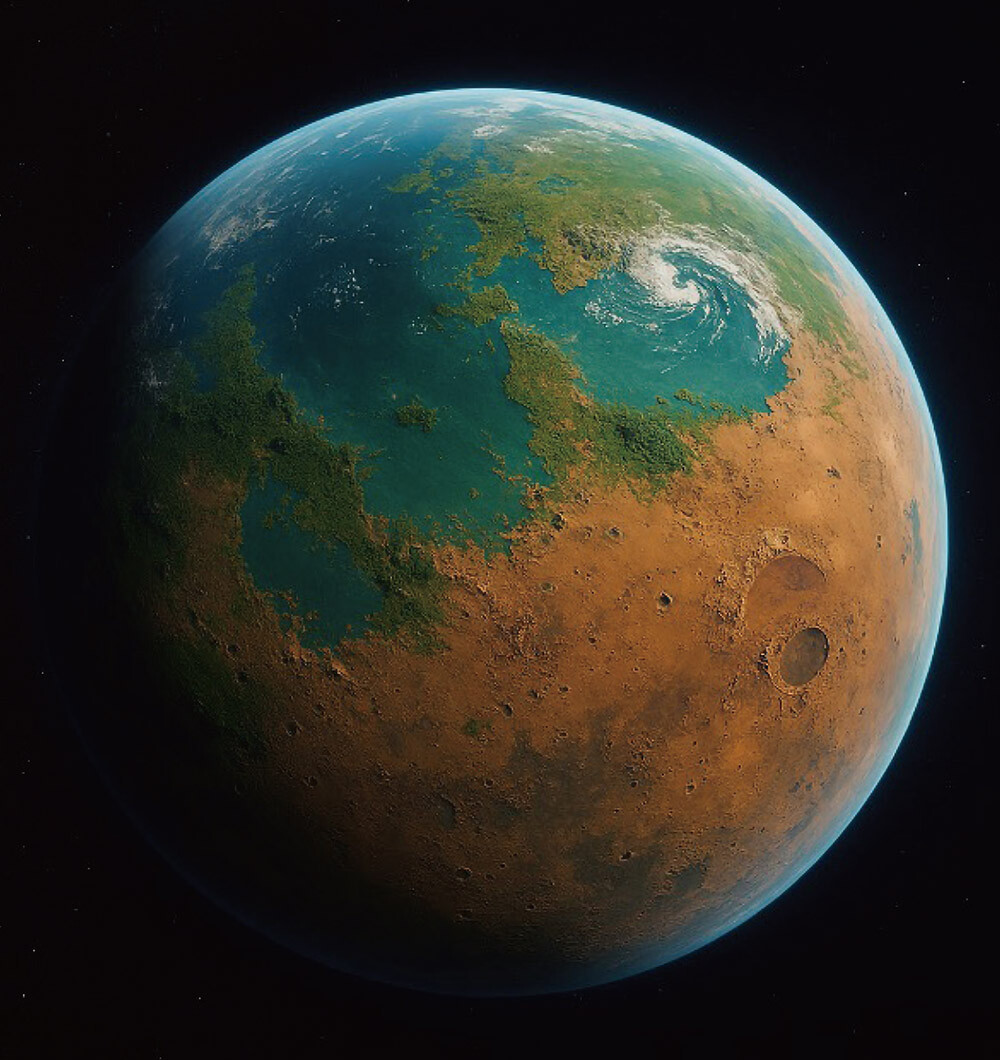
If our computer models are correct, then as recently as ~3.5 billion years ago Mars at that time was the planet with conditions that were most like Earth. The figure below shows a conceptual image of what Mars might have been like before 3.5 billion years ago. This figure reminds us of the Earth as imaged from space, and that is precisely the point. 3.5 billion years ago there were two Blue Marbles in our Solar System. By 3.5 billion years ago Earth had life—there is direct evidence of life in the ancient rocks in Greenland and Australia.
If Earth and Mars were similar during the period when life first appears in the fossil record on Earth this opens up the question of what happened on Mars at this time: Life? Transferred from Earth, or a second genesis? The organic remains of this early Earth-like period are a key target for missions to Mars and we are beginning to see them in the discoveries of organics by the Curiosity and Perseverance Rovers.
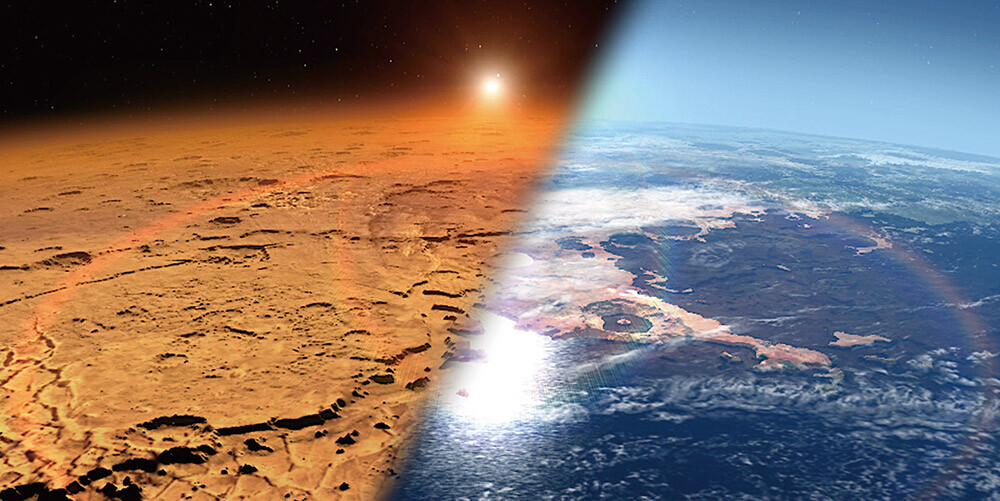
If Mars had an Earth-like water-rich environment in the distant past, how did it become the desert world we see today? We think that the dehydration of Mars and the loss of its atmosphere were the result of its lower gravity (1/3 Earth gravity), no magnetic field, and the absence of plate tectonics. All three of these factors trace back to Mars being too small. The mass of Mars is 1/10 the mass of Earth, not large enough to maintain a dynamic interior that powers plate tectonics or a global magnetic field.
We are not sure of the fate of the atmospheric gases (CO2) or water from the early period. The water and the CO2 may be buried underground or may have been lost to space. We don't know because we do not yet have clear data about the Martian subsurface. The deepest we've drilled is a few centimeters.
Can we bring Mars to life?
If Mars once had water, and possibly life, could we restore these habitable conditions? It is interesting to note that Mars was warm enough to support liquid water on its surface 3.5 billion years ago when the Sun was about 2/3 as bright as it is now. Thus, if we could bring back the thick atmosphere Mars must have had back then and the associated water, it would easily be habitable again. The key question is the total amount of CO2, water, and nitrogen that might be present below the surface. If these are present then the first step is to warm Mars which would result in these compounds coming back to the surface.
We do not have to look very far to see clear clues to how we might warm Mars. Right here on Earth we humans are warming an entire planet using greenhouse gases. It may not be a good idea on our home planet, but it would be just what is needed to start the process of making Mars habitable again.
Greenhouse gases warm a planet by trapping outgoing radiation due to absorbed solar radiation. If we trapped the solar energy reaching the surface with 100% efficiency Mars would become as warm as the Earth in less than 10 years. Of course, if we enhanced the greenhouse effect on Mars with the optimum mix of the most suitable greenhouse gases (SF6, CF4, C2F6, C3F8) the greenhouse effect would still not be 100% efficient—but it might be 10% efficient. Then the time to warm Mars would be 100 years.
The resulting thick warm atmosphere would be dominated by CO2 and N2—not unlike the Earth's atmosphere prior to about 2 billion years ago. Over time plants would convert the atmospheric CO2 to organic matter and O2 gas. The timescale for the production of O2 is very long, ~100,000 years even assuming highly efficient burial of the organic matter produced by the plants. Humans walking about on the surface would not need space suits, but they would need an O2 supply.
A thick atmosphere on Mars, even if lacking enough O2 to breathe, would have many benefits over the thin atmosphere of today. First, it would provide radiation shielding against cosmic rays and solar flares. Second, it would simplify habitat construction. Instead of having to withstand a large pressure difference, the habitat would only need to be airtight. This makes it much more practical to enclose large structures and even entire groups of buildings enclosed in one structure. The domed cities, that often grace the cover of science fiction books, are not possible on Mars today but would be possible with this thicker CO2 atmosphere.
A warmer wetter Mars even with a predominantly CO2 atmosphere with a small amount of O2 would be habitable for a diverse set of life forms including many plants, insects, and many invertebrates. It is often assumed that the life on a terraformed Mars would come from Earth. This may be the only choice if any life in Mars past has long since died out. However, the life that populates a terraformed Mars may be native if there are still remnants of an early biology. This is most interesting if the biology is a second genesis and thus represents a distinctly different origin of life from Earth life. Then Mars would be home to a global biology that is different from Earth's global biology. This case has interesting scientific possibilities as well as important ethical implications.
Currently we assume Mars does not have life and we would share life from Earth. However, we do not know for certain and so we must be careful as we explore Mars to not cause biologically irreversible contamination. This is known as the "rabbits in Australia (*1)" case.
As is clear, terraforming Mars is not making a duplicate of Earth. It is making Mars a planet that can support (once again?) a global biology. It may be more appropriately called planetary ecosynthesis rather than terraforming. It may have life that is from Earth, or it may have a restored native biota. Either way a Mars with life is of interest and value.
If human effort did result in a thick atmosphere on Mars, recapitulating ancient conditions, in time, it would escape to space due to the low gravity and the absence of a magnetic field. However, the escape rate is such that would take millions of years to lose the atmosphere—a short time compared to the history of Mars but a very long time on human timescales. A challenge perhaps for distant future generations.
*1 Rabbits in Australia are a classic example of biological invasion, which damages native ecosystems. Around the mid-19th century, 24 wild rabbits brought from Britain to Australia multiplied explosively, and as of 2026, their population has grown to over 200 million. They are now subject to control as an invasive alien species.
Should we bring life to Mars?
Terraforming Mars is a lesson in how habitable planets work. It is not a "last resort", a "Planet B" after we have destroyed the Earth. That view is ethically and technically absurd. Of course, we should prioritize Earth and maintaining the richness and diversity of life on Earth. However, there is no need to put taking care of Earth in opposition to terraforming Mars. Indeed, terraforming Mars involves learning how to create, or recreate, a habitable world. That knowledge can certainly come of use in taking care of the Earth. Mars and terraforming Mars is the first step in working out how life from Earth can expand into space.
In addition to this practical knowledge there is a deeper motivation for planetary ecosynthesis on Mars. If there is meaning in this Universe it is in life. If there is a purpose for humans in this Universe, it must be to support and enhance the richness and diversity of life—including on Earth. Maintaining the habitability of Earth and restoring the habitability of Mars may well be the first tests of how well we understand these principles.
Dr. McKay previously contributed an article titled "Mars Exploration" to Obayashi Quarterly No. 33, Mars (1990).
- Current page: page 1
- 1 / 1
Christopher P. McKay
(Planetary Scientist; Senior Scientist, NASA Ames Research Center)
Born in 1954. He received a Ph.D. in AstroGeophysics from the University of Colorado. His research focuses on the evolution of the solar system and the origin of life. He is also actively involved in planning for future Mars missions including human exploration. He is a leading researcher in the theoretical study of terraforming.
The issue this article appears
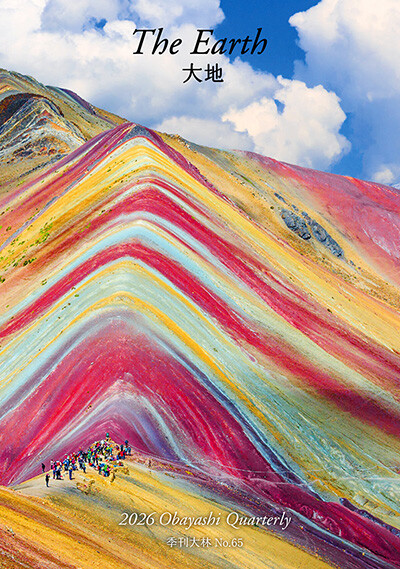
No.65 "Earth"
The earth nurtures life and sustains the rich natural environments that surround us. We live each day benefiting from its blessings. How did the earth come into being? And is there land on planets beyond Earth?
This issue explores the diverse and colorful landscapes found around the world and the ways in which they are intertwined with people’s lives. We also trace the geological processes that have shaped these distinctive landscapes. In the Obayashi Project, we took on the ambitious challenge of conceptualizing the creation of habitable terrain and the development of an environment capable of sustaining life inside a Martian crater.
We reflect on the richness and significance of the natural world nurtured by the earth and turn our thoughts to the future of our planet’s environment.
(Published in 2026)
-
The Colors and Expressions of the Earth
- View Detail
-
Earth's Soil and Planetary Soil
FUJII Kazumichi
(Unit Leader, Soil Homeostasis Research Unit, Fukushima Institute for Research, Education and Innovation) - View Detail
-
Who Owns Land in Space?: Rethinking the Ethics of Terraforming
MOTOMURA Yukiko
(Special Visiting Professor, Faculty of Life and Medical Sciences, Doshisha University; Guest Editor, The Mainichi Newspapers Co., Ltd.) - View Detail
-
Terraforming: Ecosynthesis and Ecological Restoration on Mars
Christopher P. McKay
(Planetary Scientist; Senior Scientist, NASA Ames Research Center) - View Detail
-
OBAYASHI PROJECT
Creating Habitable Terrain on Mars: Crater Paraterraforming
Concept: Obayashi Project Team
- View Detail
-
Dreams of the Red Earth: Five Hundred Years of Martian Settlement
TAKEUCHI Kaoru
(Science Writer; Professor, Faculty of Social Informatics, ZEN University) - View Detail
-
The "Earthen Houses" of Iceland
FUJIMORI Terunobu
(Architectural historian and architect; Director, Tokyo Metropolitan Edo-Tokyo Museum; and Emeritus Professor, University of Tokyo) - View Detail
-
The Earth's Memory: Landscapes Shaped by Nature and Human Life
- View Detail