

Creating Habitable Terrain on Mars: Crater Paraterraforming
Concept: Obayashi Project Team
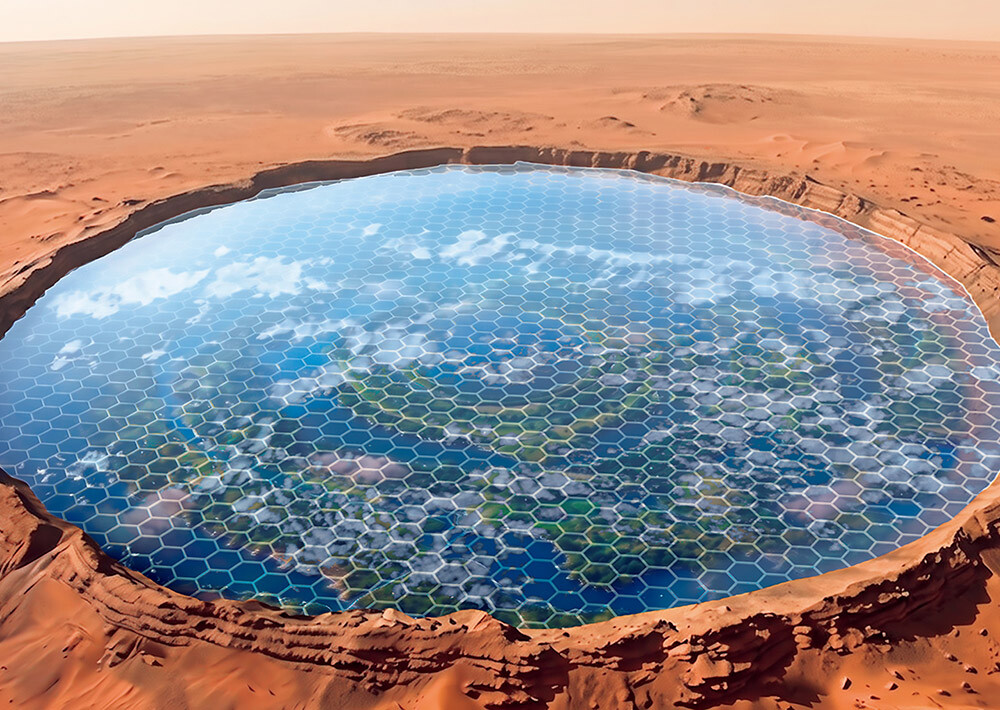
In humanity's future expansion into space, Mars is widely regarded as the most promising candidate for human habitation. As a planet with a solid surface like Earth, it has long inspired scientists and engineers to explore its potential. In reality, however, Mars is an inhospitable world, dominated by a thin atmosphere, intense radiation, and severe cold.
The concept of transforming such an environment into one capable of sustaining life is known as terraforming. By altering the climate of the entire planet, terraforming seeks to create conditions closer to those of Earth. Yet the idea involves more than simply constructing a habitable environment from scratch. Traces of ancient water flows have been discovered on Mars, suggesting that the planet may once have possessed a warmer climate and substantial quantities of liquid water. It is even possible that conditions once existed in which microbial life could emerge and survive. In this sense, the terraforming of Mars may also be understood as an attempt to restore a lost environment from the planet's distant past. Realizing such a vision, however, would require immense amounts of energy and time, while also presenting a wide range of technological challenges.
With this in mind, the Obayashi Project Team explored an approach based not on transforming the entire planet, but on recreating an Earth-like natural environment within a limited portion of the Martian landscape through a concept known as paraterraforming (*1). A giant canopy would enclose a crater, within which gases and water would be collected from the Martian atmosphere and subsurface. Life forms would then be introduced in stages, gradually greening the environment and transforming it into a living ecosystem. In doing so, the project would also serve as the setting for a grand experiment—one that reminds us how extraordinary Earth's natural environment truly is: a world where rain falls, winds blow, forests grow, and animals nurture life.
*1 A form of partial or pseudo-terraforming in which an Earth-like environment is created within a limited area of a planet rather than over an entire planet. The prefix para- implies something analogous to or modeled after the original concept of terraforming.
Prologue—Humanity's Enduring Dream of Inhabiting Space
Since the 1980s, OBAYASHI CORPORATION has been envisioning a future in which humanity lives in space from a practical and technical perspective, integrating cutting-edge science with construction technologies. These visions have included concepts such as the Lunar City 2050, Mars Habitation 1 (a Mars settlement plan), the space-city concept Space Nut II to be constructed at a Lagrange point (*2), and the Space Elevator, a 100,000-km tower connecting Earth and space (*3).
Mars Habitation 1 envisions the construction of a settlement equipped with farms capable of maintaining food self-sufficiency. In this vision, life on Mars in 2057 would be largely self-sufficient, with a baby born on Mars and a population of 500 living there. The vision also includes regular interplanetary transport services between Earth and Mars via large shuttle spacecraft.
Since ancient times, humanity has regarded the red-glowing planet Mars with a sense of awe, speaking of it symbolically as Mars, the god of war, while at the same time harboring a deep fascination with it.
The idea of intelligent life on Mars began to capture the human imagination at the end of the 19th century, after the astronomer Giovanni SCHIAPARELLI observed linear formations on Mars that he called canali ("channels"). The term was mistakenly translated into English as "canals," giving rise to the theory that vast artificial waterways built by intelligent beings crisscrossed the Martian surface. This theory was enthusiastically promoted by the American astronomer Percival LOWELL. Mars came to be imagined as a world inhabited by intelligent life, inspiring countless works of science fiction ranging from stories of extraterrestrial invasion and interplanetary conflict to tales of adventure. For humanity, Mars became the nearest "other world," a place that inspires both awe and fascination.
That dream darkened in 1965, however, when Mariner 4 spacecraft of the United States' National Aeronautics and Space Administration (NASA) approached Mars and transmitted images of a barren, crater-covered landscape. Mars proved to be a world far too hostile for life: an atmosphere less than 1 % as dense as Earth's, composed primarily of carbon dioxide, and an average surface temperature of -60 ℃. The "canals" astronomers believed they had seen were ultimately revealed to be optical illusions caused by the limits of telescope resolution.
Yet humanity did not abandon its dream. As the prospect of intelligent life on the planet receded, a new possibility began to take shape: perhaps Mars itself could be transformed into a world habitable by humans. From this idea emerged the new dream of terraforming—reshaping the Martian environment into a habitable world for humans. The concept involved thickening the atmosphere, warming the planet, maintaining water in its liquid state, and allowing natural processes to gradually green the landscape. Although such ambitions would require immense spans of time and energy far beyond current technological capabilities, scientists have continued to explore them in earnest.
In the meantime, traces suggesting that water once flowed across the Martian surface have been discovered, leading researchers to consider the possibility that Mars may once have possessed a warm environment much like that of Earth. Significant quantities of water likely existed there, forming seas and lakes, and dramatically altering the composition and structure of the Martian surface through hydrological activity. The possibility that life may once have emerged on Mars has also been raised. However, owing in part to the planet's relatively weak gravity, Mars is thought to have gradually transformed into the dry and desolate world we know today.
This project focuses on the restoration of a temperate Mars and the creation of new terrain through paraterraforming. In recent years, organizations including NASA, Japan Aerospace Exploration Agency (JAXA), the European Space Agency (ESA), as well as countries such as China and the United Arab Emirates, have advanced technologies for future crewed exploration and sample-return missions designed to bring Martian soil and rock samples back to Earth. At the same time, private companies have also begun pursuing missions to Mars. Humanity's first steps onto our neighboring planet are no longer confined to the realm of fantasy.
Against this backdrop, we sought not simply to transplant Earth's environment to Mars in pursuit of human interests, but to envision an approach that would make use of the planet's own inherent characteristics. Our aim was to create a natural environment suited specifically to Mars and, ultimately, to apply the knowledge gained through efforts to restore and green the Martian landscape toward the restoration of Earth's environment as well. Moreover, conventional terraforming studies have rarely addressed the process of greening. This perspective constitutes one of the defining features of our project.
Terraforming inevitably raises ethical questions, including the alteration of extraterrestrial environments and the potential impact on possible forms of non-terrestrial life. This project, however, is intended solely as an exploration and examination of possibilities from scientific and engineering perspectives.
*2 A stable point in space where the gravitational forces of celestial bodies are in equilibrium. Such regions are considered well suited to the construction of large-scale space structures.
*3 Specifically, the following concepts: "Moon" published in Obayashi Quarterly (OQ) No. 25 (1987), "Mars" in OQ No. 33 (1990), "Lagrange Point" in OQ No. 41 (1996), and "Tower" in OQ No. 53 (2012).
Creating Habitable Terrain on Mars: A Bold Challenge—The Purpose of the Largest Civil Engineering Project in the Solar System
1. Creating Habitable Terrain on Mars: The Aims of the Concept
Why Paraterraforming?
The term "terraforming" derives from the Latin terra, meaning "Earth" or "land," and refers to the ambitious concept of transforming an entire planet into an Earth-like environment. Among the planets in our solar system, Mars—whose environmental conditions most closely resemble those of Earth—has long been considered the most promising candidate for such an undertaking. Its gravity is approximately one-third that of Earth, the length of a day is about 24 hours and 40 minutes, and its axial tilt is roughly 25.1 ° (Earth: approx. 23.4 °), resulting in similar seasonal changes.
In 2018, however, a paper published by NASA's research team fundamentally shook the feasibility of terraforming. After closely examining the total amount of carbon dioxide present on Mars, the team concluded that there was nowhere near enough to generate breathable levels of oxygen for humans. Only about 7 % of the required amount was found, leading NASA to conclude that terraforming the entire planet was effectively impossible.
It was against this backdrop that our project began exploring the idea of paraterraforming. Proposed in 1992 by physicist Richard L. S. TAYLOR, paraterraforming envisions creating Earth-like conditions within only a limited portion of a planet.
Our project envisions covering craters on the Martian surface with canopies that allow as much light through as possible, creating enclosed environments with breathable atmospheres inside. Because the required atmospheric volume is limited to only a handful of craters, the scarce carbon dioxide reserves of Mars would be sufficient. Compared with planetary-scale terraforming, the resources and energy required would be reduced by orders of magnitude, making the concept far more achievable from a technological standpoint as well.
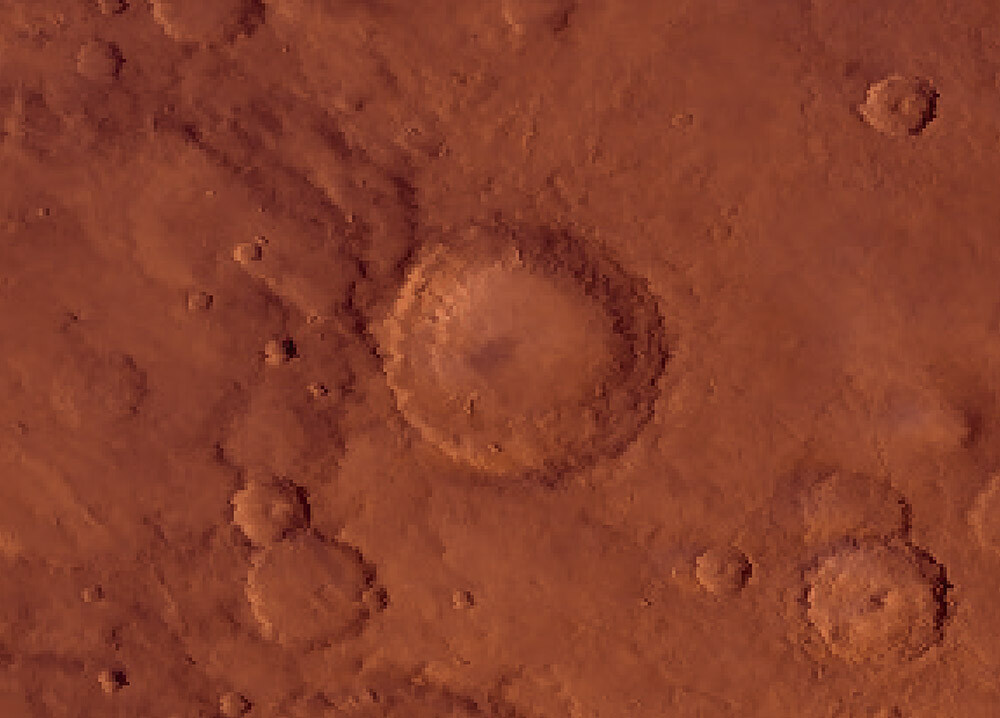
The project team brought together in-house specialists from a wide range of fields, including aerospace engineering, geophysics, environmental engineering, soil science, ecology, materials engineering, geotechnical engineering, architectural engineering, and civil engineering. The members conducted detailed analyses of the harsh environmental conditions of Mars and examined the specific technological elements required to make paraterraforming a reality.
The aims of this project can be distilled into three principal objectives. The first is to recreate Earth's natural environment on Mars and green its terrain. The second is to deepen our awareness of the extraordinary conditions and precious value of natural environments through that process. The third is to provide an opportunity to view environmental restoration on Earth from an entirely new perspective.
Recreating within Martian craters the atmosphere and ecosystems that took 4.6 billion years to evolve on Earth, and to do so within a comparatively short span of time, would constitute the largest civil engineering enterprise in the solar system. At the same time, it would also be an attempt to reexamine the miracle of the planet Earth.
Why Craters?
The greatest technical challenge of paraterraforming lies in determining how a canopy capable of covering the Martian landscape can be made structurally viable.
At the outset, the project team considered constructing dome-shaped canopies over flat terrain. However, this approach was soon found to contain a fatal mechanical problem.
The atmospheric pressure of Mars is approximately 0.006 atmospheres—close to a vacuum. In other words, creating pressure inside the enclosed space that humans could breathe (*4) would generate an enormous pressure differential between the interior and exterior of the canopy.
This pressure differential acts upon the structure in two distinct directions.
One is a vertical force that pushes the canopy upward from within. This can be addressed by adjusting the weight of the canopy itself so that the upward force produced by internal pressure balances the downward force generated by gravity. If the two forces are brought into near equilibrium, the structural burden imposed on the canopy can be dramatically reduced, making even an extremely thin membrane structure theoretically feasible.
The second force, however, acts horizontally and poses a far more serious structural problem. The pressure differential between the inside and outside of the canopy (approx. 0.5 atm) acts as a lateral force that pushes the structure outward. The scale of paraterraforming envisioned by this project extends to roughly 50 km in diameter and 2.5 km in height. In the case of installing a dome-shaped canopy on flat ground, airtightness cannot be maintained unless the canopy itself, or the surrounding structure, is capable of withstanding the immense lateral forces exerted from within.
The lower gravity of Mars contributes little toward solving this problem. Because the lateral pressure differential arises regardless of gravitational strength, the very idea that an artificial structure on flat terrain could resist such horizontal forces is fundamentally impractical.
The key to resolving this structural challenge lies in the use of craters. Craters possess elevated rims surrounding depressed central basins. By utilizing the crater rim as a structural wall, it becomes far easier both to maintain airtightness at the perimeter and to resist the lateral forces generated from within. In essence, the crater itself becomes a natural container.
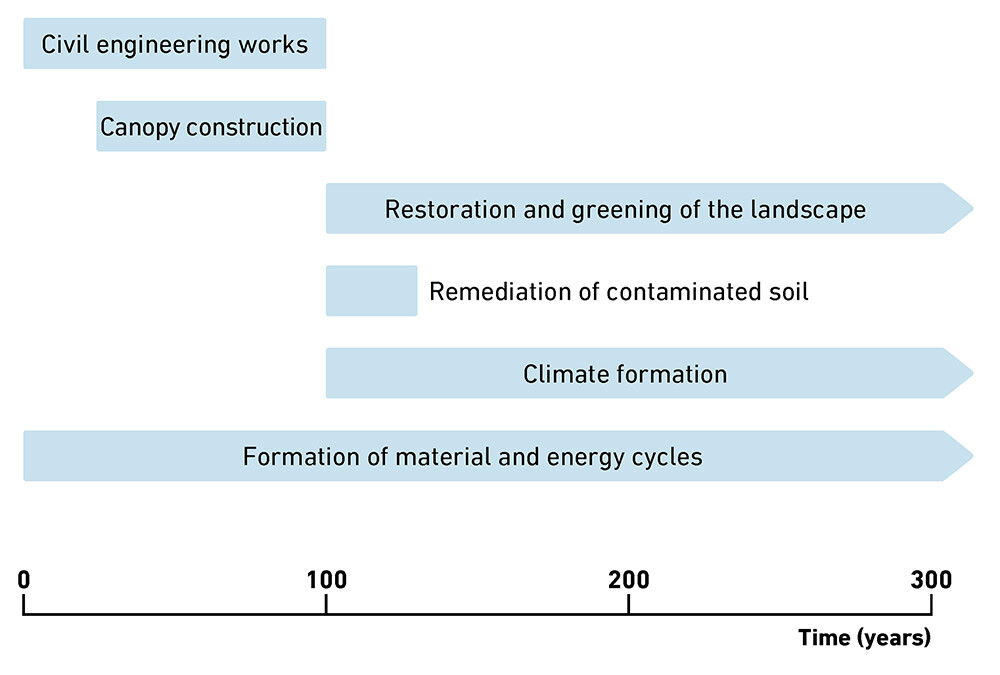
The entire paraterraforming process was estimated to take approximately 300 Earth years to complete. Even after paraterraforming advances, the appearance of Mars would remain largely unchanged. Across the planet's red landscape, scattered green oases enclosed beneath translucent canopies would appear like jewels in the desert.
[Overall Timeline for Crater Paraterraforming]
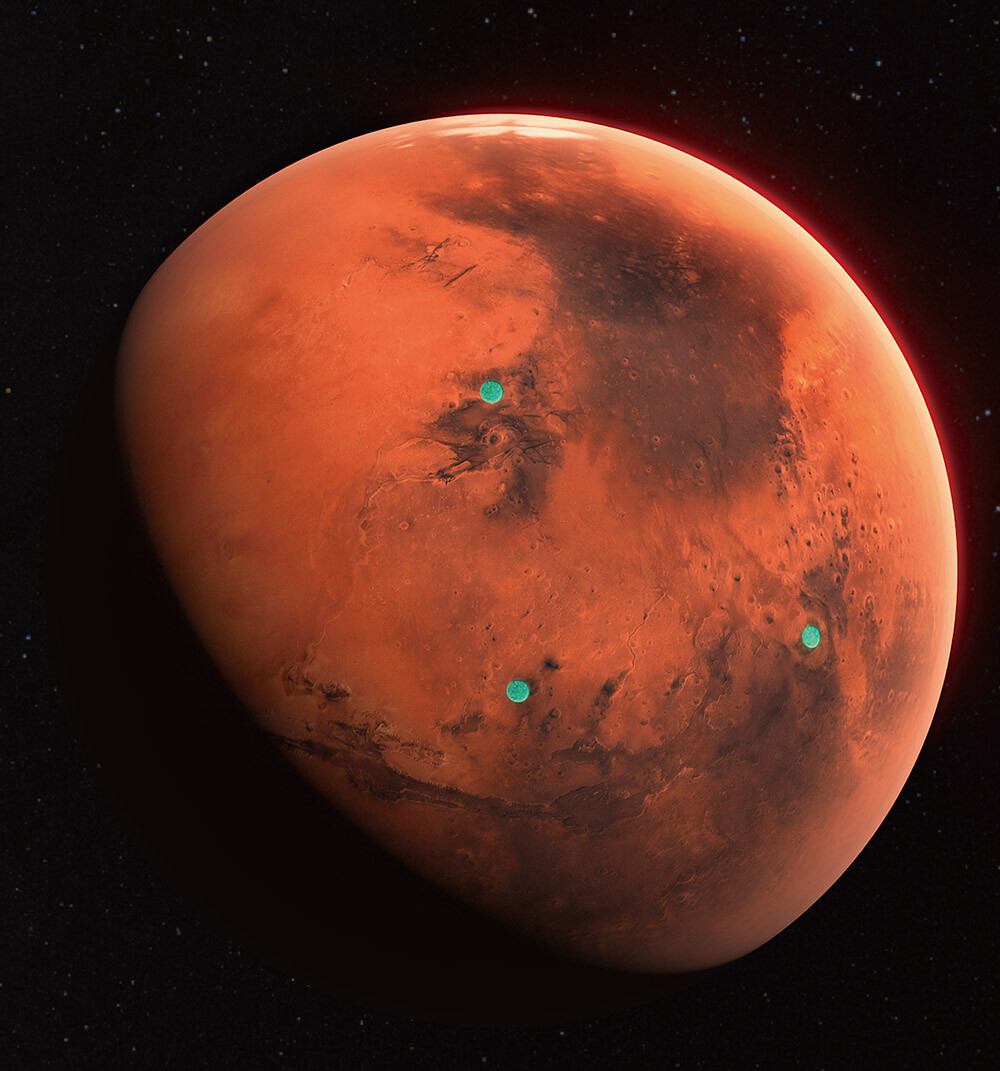
*4 Within the enclosed space beneath the canopy envisioned in this project, an atmosphere with an oxygen partial pressure of 0.2 atmospheres—the same as Earth's atmosphere—would be created and, together with nitrogen, maintained at a total pressure of 0.5 atmospheres.
The issue this article appears
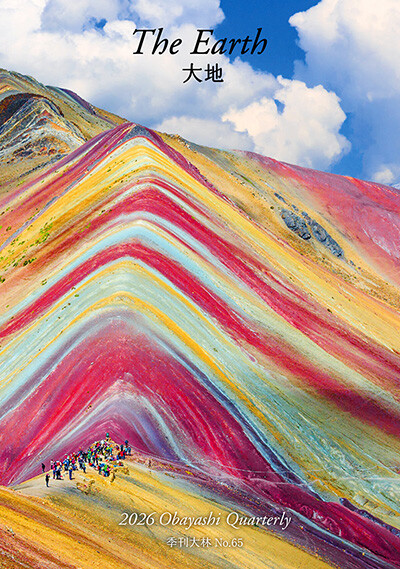
No.65 "Earth"
The earth nurtures life and sustains the rich natural environments that surround us. We live each day benefiting from its blessings. How did the earth come into being? And is there land on planets beyond Earth?
This issue explores the diverse and colorful landscapes found around the world and the ways in which they are intertwined with people’s lives. We also trace the geological processes that have shaped these distinctive landscapes. In the Obayashi Project, we took on the ambitious challenge of conceptualizing the creation of habitable terrain and the development of an environment capable of sustaining life inside a Martian crater.
We reflect on the richness and significance of the natural world nurtured by the earth and turn our thoughts to the future of our planet’s environment.
(Published in 2026)
-
The Colors and Expressions of the Earth
- View Detail
-
Earth's Soil and Planetary Soil
FUJII Kazumichi
(Unit Leader, Soil Homeostasis Research Unit, Fukushima Institute for Research, Education and Innovation) - View Detail
-
Who Owns Land in Space?: Rethinking the Ethics of Terraforming
MOTOMURA Yukiko
(Special Visiting Professor, Faculty of Life and Medical Sciences, Doshisha University; Guest Editor, The Mainichi Newspapers Co., Ltd.) - View Detail
-
Terraforming: Ecosynthesis and Ecological Restoration on Mars
Christopher P. McKay
(Planetary Scientist; Senior Scientist, NASA Ames Research Center) - View Detail
-
OBAYASHI PROJECT
Creating Habitable Terrain on Mars: Crater Paraterraforming
Concept: Obayashi Project Team
- View Detail
-
Dreams of the Red Earth: Five Hundred Years of Martian Settlement
TAKEUCHI Kaoru
(Science Writer; Professor, Faculty of Social Informatics, ZEN University) - View Detail
-
The "Earthen Houses" of Iceland
FUJIMORI Terunobu
(Architectural historian and architect; Director, Tokyo Metropolitan Edo-Tokyo Museum; and Emeritus Professor, University of Tokyo) - View Detail
-
The Earth's Memory: Landscapes Shaped by Nature and Human Life
- View Detail