

Creating Habitable Terrain on Mars: Crater Paraterraforming
Concept: Obayashi Project Team
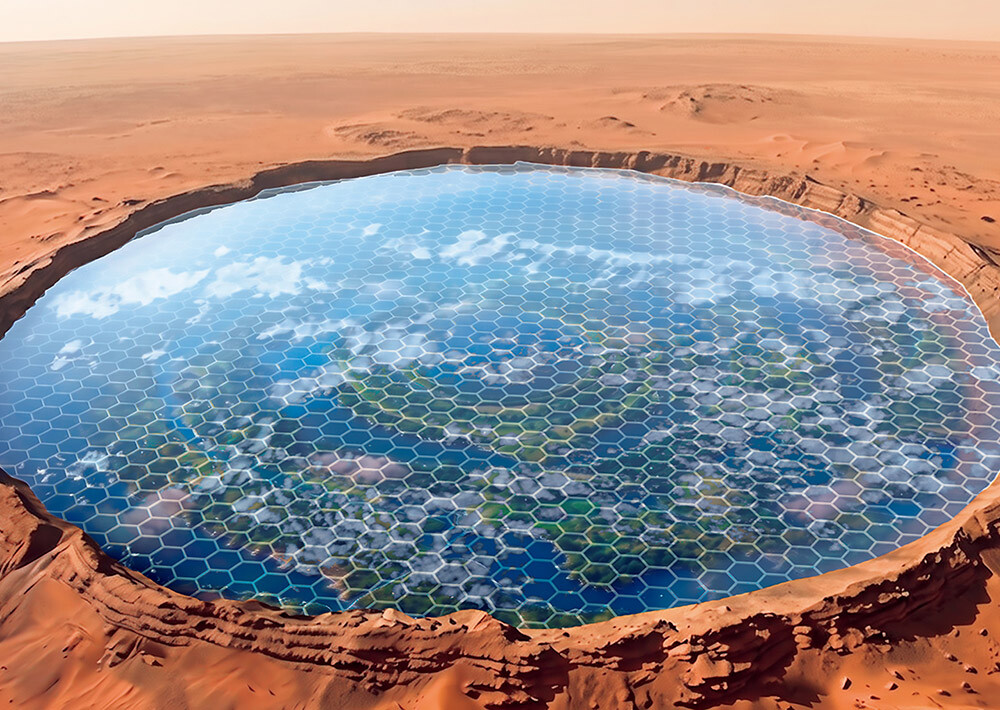
The Significance of Creating Habitable Terrain—Reexamining Earth's Miracle
After some 300 years, the paraterraforming project reaches a stage of near completion. At the bottom of craters once covered in reddish-brown rock and dust, blue lakes and green forests spread, and gentle winds move across the grasslands. Beneath sunlight filtered through the canopy, people breathe and walk upon the land as they do on Earth. The atmosphere with an oxygen partial pressure of 0.2 atmospheres and a nitrogen partial pressure of 0.3 atmospheres corresponds to conditions found in Earth's highlands, reaching a range in which healthy adults can live without difficulty.
Yet this is not Earth; it is Mars, a planet that has undergone its own independent evolution within its unique environment. Clouds form in the sky, and only limited rainfall occurs; artificial precipitation is circulated through dehumidification systems and water channels. While cultivating microorganisms and plants over a period of 200 years to generate oxygen, it was also necessary to remove toxic substances and build up organic matter from scratch in order to form soil. Each element that is commonplace on Earth has finally been obtained on Mars through immense investments of time and engineering effort. Upon standing on Martian ground, humanity will come to fully understand how delicately balanced Earth's natural environment truly is.
Rain falls, rivers flow, forests grow, and animals move across the land as a result of the interplay of conditions such as the planet's mass, its distance from the Sun, the composition of its atmosphere, the presence and strength of its magnetic field, and the existence of liquid water. Every landscape we take for granted in daily life is the product of such a rare convergence of conditions.
One day, when green oases emerge within Martian craters, they will stand as a testament to humanity's technological achievements and as a powerful reminder of how carefully we must safeguard Earth's environment.

Project Summary
Global interest in the terraforming of Mars shows no sign of fading. As unmanned exploration reveals more of the planet's true nature, the fundamental concepts underlying Martian terraforming are likewise evolving. In this project, we aimed to present an unprecedentedly comprehensive vision of terraforming Mars by integrating the latest scientific insights with evolving construction technologies.
Why should a construction company turn its attention to space, particularly Mars? Several answers may be offered. First, constructing structures in space, much like those on Earth, requires collaboration among specialists from a wide range of disciplines. Whether on Earth or in space, creating any structure requires expertise in structural engineering, materials, architectural design, building systems, and more. The principal difference lies in gravity. On Earth, construction is governed by the familiar gravitational environment we experience every day, commonly expressed as 1G, whereas space presents conditions of microgravity or reduced gravity. On Mars, structures must be designed for an environment with about one-third of Earth's gravity (approx. 1/3G). In this project, specialists from a wide range of fields worked together in a cross-disciplinary effort that fully leveraged the distinctive strengths of a construction company. By drawing on the company's comprehensive expertise in engineering, technology, and research, the team developed a vision for the future of Mars shaped by the distinctive perspective of a construction company, grounded in original ideas and sound technical reasoning.
A second perspective is that gravitational bodies such as the Moon and Mars possess "ground." Because structures can be built upon a ground surface, the technologies of construction companies can be applied to their fullest extent. Mars in particular is composed primarily of igneous rock, and the traces of ancient flowing water suggest that secondary minerals produced through weathering of rocks may once have formed there. In addition, as on Earth, the raw materials necessary for the creation of soil are present. Mars is therefore an ideal setting for this project's objective: the creation of habitable terrain. The two essential steps toward that goal—soil formation and greening—are areas where construction companies have extensive expertise. The project also drew on technologies the construction industry has developed and refined in recent years, including techniques for remediating contaminated soil.
Third, like major construction projects on Earth, the project would unfold as a long-term megaproject involving the construction of large-scale infrastructure over many years. It is essential to coordinate diverse professions and construction processes efficiently, draw up an optimal schedule, and carry out construction while carefully managing that schedule. In this sense, the project's planning philosophy is fundamentally consistent with that of construction projects on Earth.
Within this project, the culmination of paraterraforming was defined as the completion of the process of creating habitable terrain on Mars. The epilogue envisions the moment when, for the first time within a sealed environment, humans remove their oxygen masks and breathe the natural atmosphere with their own lungs. What follows beyond that moment is left to the imagination of the reader.
Finally, it is worth considering what significance this project may hold for humanity. On Earth, life emerged and, over immense spans of time, evolved while acquiring diversity, intelligence capable of using tools, and ecosystems sustained through coexistence with microorganisms, plants, and animals. In recent years, civilization has advanced at an unprecedented pace, while existential threats such as climate change and nuclear war have likewise emerged. Some projections suggest that if humanity's productive capacity continues to increase at its current rate, Earth's resources may eventually prove insufficient to sustain it. Although we recognize that the expansion of the biosphere into the solar system remains a matter of debate, we believe humanity will continue to extend the foundations of its activity to the Moon and Mars in the future.
This project envisioned a process spanning approximately 300 years—an exceptionally long timeframe even for Obayashi Quarterly. Some may question the value of projects that transcend generations. Yet just as a single fortuitous act by one of our distant ancestors may have profoundly shaped the lives we lead today, so too might the small efforts we undertake for future generations contribute greatly to the well-being of people living in the distant future.
Without venturing into timescales of millions or even hundreds of millions of years into the future, the humanity that one day experiences the creation of habitable terrain on Mars—who may even have evolved into forms of life quite different from our own—will inherit our civilization and technologies, while continuing to carry forward our aspirations and hopes. This project is intended to serve as a foundation for the continuity and prosperity of future generations.
Finally, we would like to express our sincere gratitude to Dr. ARAI Mayumi, a board member of the Mars Society Japan for the invaluable knowledge and insights generously shared during the development of this project.
Obayashi Project Team
<Obayashi Corporation>
-
Technology Division:
ISHIKAWA Yoji, KAWAKAMI Yoshihiro, OTSUKA Kiyotoshi, SUGIMOTO Hideo, MATSUBARA Takashi, NIINOBE Ryuta, FUJII Miyuki, and NAKATA Mikihisa -
Engineering Division:
HIGASAYAMA Tetsumi and NISHIKAWA Naohito -
Architectural Design & Engineering Division:
NAGAYA Keiichi and OMURA Hiroki -
Building Construction Division:
HORIKAWA Tomoya, MAEDA Ryota, and MATSUBARA Kota -
Civil Engineering Construction Division:
MORITA Koji and SASAKI Toru -
Construction Robotics Division:
HISADA Hideki
<Obayashi Design Partners>
- MATSUSHITA Takashi
- The first page
- Previous page
- page 1
- page 2
- page 3
- page 4
- Current page: page 5
- 5 / 5
The issue this article appears
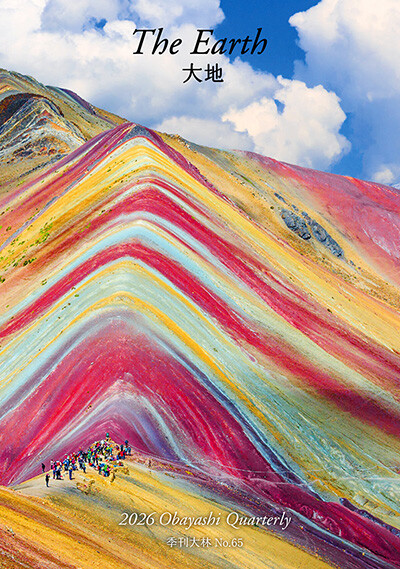
No.65 "Earth"
The earth nurtures life and sustains the rich natural environments that surround us. We live each day benefiting from its blessings. How did the earth come into being? And is there land on planets beyond Earth?
This issue explores the diverse and colorful landscapes found around the world and the ways in which they are intertwined with people’s lives. We also trace the geological processes that have shaped these distinctive landscapes. In the Obayashi Project, we took on the ambitious challenge of conceptualizing the creation of habitable terrain and the development of an environment capable of sustaining life inside a Martian crater.
We reflect on the richness and significance of the natural world nurtured by the earth and turn our thoughts to the future of our planet’s environment.
(Published in 2026)
-
The Colors and Expressions of the Earth
- View Detail
-
Earth's Soil and Planetary Soil
FUJII Kazumichi
(Unit Leader, Soil Homeostasis Research Unit, Fukushima Institute for Research, Education and Innovation) - View Detail
-
Who Owns Land in Space?: Rethinking the Ethics of Terraforming
MOTOMURA Yukiko
(Special Visiting Professor, Faculty of Life and Medical Sciences, Doshisha University; Guest Editor, The Mainichi Newspapers Co., Ltd.) - View Detail
-
Terraforming: Ecosynthesis and Ecological Restoration on Mars
Christopher P. McKay
(Planetary Scientist; Senior Scientist, NASA Ames Research Center) - View Detail
-
OBAYASHI PROJECT
Creating Habitable Terrain on Mars: Crater Paraterraforming
Concept: Obayashi Project Team
- View Detail
-
Dreams of the Red Earth: Five Hundred Years of Martian Settlement
TAKEUCHI Kaoru
(Science Writer; Professor, Faculty of Social Informatics, ZEN University) - View Detail
-
The "Earthen Houses" of Iceland
FUJIMORI Terunobu
(Architectural historian and architect; Director, Tokyo Metropolitan Edo-Tokyo Museum; and Emeritus Professor, University of Tokyo) - View Detail
-
The Earth's Memory: Landscapes Shaped by Nature and Human Life
- View Detail